
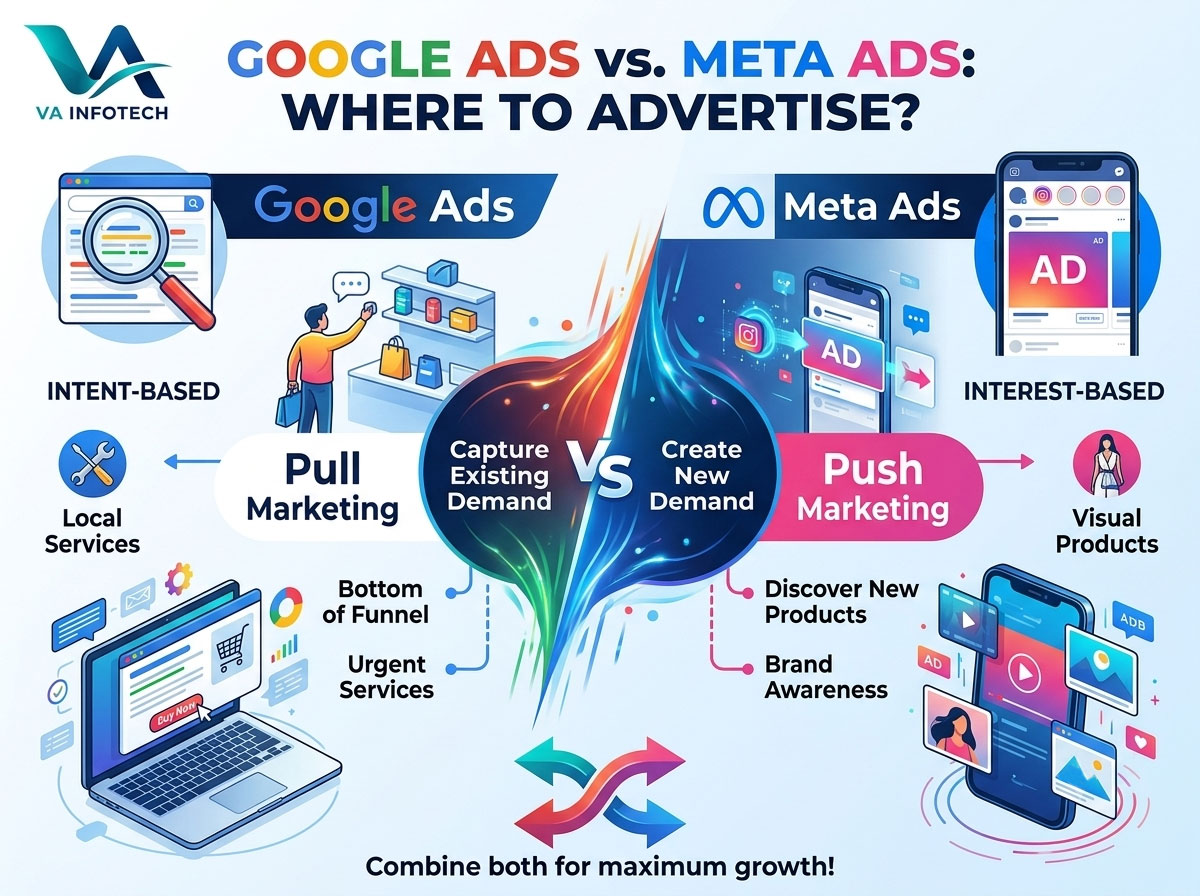
Every business with a marketing budget eventually asks the same question: Google Ads or Meta Ads? It sounds like a simple either/or decision, but the two platforms work in almost opposite ways — one captures people who are already looking for what you sell, the other puts your business in front of people who weren’t looking at all. Choosing wrong doesn’t just waste budget; it can quietly starve a campaign that would have worked fine on the other platform.
This guide breaks down exactly how each platform works, what they cost in 2026, where each one wins, and how to decide — including when running both at once is actually the smarter move.
The Core Difference: Intent vs. Discovery
Before comparing costs and features, it’s worth understanding the fundamental difference in how these two platforms find customers for you.
Google Ads is intent-based advertising. Someone types “emergency plumber near me” or “best CRM software for small teams” into Google, and your ad appears because you bid on that exact phrase. The person is already in problem-solving mode — they want a solution now, and you’re offering to be it. This is often called “pull” marketing: the customer pulls the ad toward them through their own search behavior.
Meta Ads is interest-based advertising. Someone is scrolling Instagram or Facebook, not thinking about your product at all, and your ad interrupts their feed based on their demographics, interests, past behavior, or similarity to your existing customers. This is “push” marketing: you push the offer toward someone who wasn’t necessarily searching for it.
Neither approach is better in the abstract — they solve different problems. Google Ads is built to capture demand that already exists. Meta Ads is built to create demand and awareness where none existed yet.
Google Ads vs Meta Ads: Cost Comparison for 2026
Cost is usually the first question business owners ask, and it’s also the most misleading number if you look at it in isolation.
| Metric | Google Ads (Search) | Meta Ads (Facebook/Instagram) |
|---|---|---|
| Average CPC | Roughly $2–5, higher in competitive industries | Roughly $0.70–1.20 |
| Average CTR | 3–7% depending on industry | 1–2% across placements |
| Average conversion rate | 4–8% | 1–3% |
| Average cost per lead/acquisition | $40–90, varies heavily by industry | $25–45, varies heavily by industry |
| Minimum realistic monthly budget | ₹25,000–75,000 for most SMBs | ₹15,000–50,000 for most SMBs |
At a glance, Meta looks like the cheaper platform — and per click, it usually is. But cost-per-click isn’t the number that pays your bills; cost-per-customer is. Because Google traffic arrives with existing purchase intent, it tends to convert at a noticeably higher rate, which often closes the cost gap by the time you look at actual cost-per-lead or cost-per-sale. Meta, meanwhile, wins on cost-per-impression and cost-per-follower, making it far more efficient for pure reach and brand-building goals.
The honest takeaway: don’t compare CPC alone. Compare cost-per-outcome — the metric tied to what you actually want (a sale, a lead, a booked call) — and that number depends heavily on your industry, offer, and how well the campaign is built, not just which platform you pick.
Where Google Ads Wins
1. High-intent, bottom-of-funnel searches. If someone is actively typing “buy,” “price,” “near me,” or a specific product name into Google, they’re close to a decision. Google Ads puts you directly in front of that moment.
2. Local service businesses. Plumbers, dentists, lawyers, real estate agents, and repair services thrive on Google Ads because customers search for these services only when they urgently need them — and Google Local Service Ads and Search campaigns capture that moment precisely.
3. B2B and long-consideration purchases. Software, industrial equipment, and professional services with longer sales cycles tend to perform better on Google, where buyers are actively researching solutions, rather than Meta, where they’d need to be interrupted mid-scroll to even think about the category.
4. Measurable, direct-response campaigns. Google’s auction and reporting are built around measurable actions — calls, form fills, purchases — making it easier to calculate a clean return on ad spend for performance-driven businesses.
Where Meta Ads Wins
1. Brand awareness and new-audience discovery. If your target customer doesn’t know they need your product yet, Google Ads can’t help — nobody is searching for a problem they don’t know they have. Meta’s interest and behavior targeting can put your brand in front of exactly the right audience before they ever search for it.
2. Visually driven products. Fashion, home decor, food, fitness, beauty, and lifestyle brands benefit enormously from Meta’s image, video, carousel, and Reels ad formats — formats Google’s primarily text-based Search ads simply don’t offer.
3. Retargeting website visitors. Someone browsed your site and left without buying. Meta Ads is exceptionally strong at bringing that visitor back with a tailored ad in their feed, often at a fraction of the cost of a fresh Google click.
4. Lower budget entry point. Because CPCs and CPMs are generally lower, Meta lets smaller businesses test creative, audiences, and offers without needing as large a budget commitment as a competitive Google Search auction.
5. Community and engagement building. Comments, shares, and social proof compound on Meta in a way they simply don’t on a Google Search ad — useful for businesses that want ongoing brand presence, not just a one-time click.
A Quick Decision Framework
If you only have budget for one platform right now, ask these questions:
- Do people actively search for what you sell? (e.g., “wedding photographer in Ahmedabad”) → Start with Google Ads.
- Is your product something people discover rather than search for? (e.g., a new skincare brand) → Start with Meta Ads.
- Is your sales cycle long and considered, like B2B software? → Google Ads for capturing research-stage intent, Meta for staying visible during that research window.
- Do you sell a visually appealing product to a broad consumer audience? → Meta Ads, with Google Shopping as a strong complement.
- Do you need measurable leads or calls fast, on a tight budget? → Google Ads, tightly focused on high-intent keywords.
Why Most Growing Businesses Eventually Use Both
In practice, the strongest-performing accounts we manage rarely pick one platform and ignore the other — they use each for what it does best. A typical effective structure looks like this:
- Meta Ads builds awareness, drives traffic, and fills the top of the funnel with people who fit the ideal customer profile but weren’t actively searching yet.
- Google Ads captures the bottom of the funnel — the same people (and others) once they’re actively comparing options and ready to act.
- Meta retargeting brings back the visitors from both channels who didn’t convert the first time, at a much lower cost than acquiring a fresh visitor.
This combination consistently outperforms either platform running alone, because it matches the ad to where the customer actually is in their decision journey — instead of assuming every customer is either already searching or needs to be introduced to your brand from zero.
Common Mistakes Businesses Make Choosing Between Them
- Judging a platform on CPC alone, without looking at conversion rate or cost-per-outcome.
- Running Meta Ads with a Google Ads mindset — direct, sales-heavy copy rarely performs as well in a social feed as content that feels native to the platform.
- Abandoning a platform after two weeks because early results look weak — both platforms need a learning period (Meta’s algorithm especially needs volume to optimize delivery).
- Ignoring tracking setup. Without proper conversion tracking (Google Tag Manager, Meta Pixel/Conversions API, and clean UTM parameters), it’s impossible to know which platform is actually driving revenue — both platforms will simply look expensive.
- Splitting a small budget evenly across both platforms instead of concentrating it where the data says it’s working, which under-funds both and produces weak results everywhere.
Frequently Asked Questions
Is Google Ads or Meta Ads better for a small business? It depends on what you sell and how customers find businesses like yours. Local, urgent-need services usually do better starting with Google Ads. Visually appealing consumer products with a broader appeal usually see better early traction on Meta Ads, especially on a limited budget.
Which platform is cheaper to run? Meta Ads typically has a lower cost-per-click and cost-per-impression. Google Ads clicks cost more but often convert at a higher rate, so the real cost-per-customer can end up closer than the CPC numbers suggest.
Can I run both platforms at the same time on a small budget? Yes, but it’s usually better to start focused on one platform, get it converting well, and then expand into the second — rather than splitting a small budget too thin across both from day one.
Which platform is better for B2B lead generation? Google Ads generally wins for direct B2B lead capture, since buyers actively search for business solutions. Meta and LinkedIn Ads work well as a supporting layer to stay visible during a buyer’s longer research and evaluation process.
How long before I know if a campaign is working? Give Google Ads at least 2–3 weeks of consistent spend to gather enough data, and give Meta Ads a similar window since its algorithm needs volume to optimize ad delivery efficiently. Judging results in the first few days on either platform usually leads to premature, costly decisions.
Final Thoughts
There’s no universal winner between Google Ads and Meta Ads — only the platform that matches how your specific customers actually make buying decisions. Businesses selling to active searchers with urgent or specific needs tend to see faster returns on Google Ads. Businesses selling visually driven, discovery-based products tend to see stronger, cheaper growth on Meta Ads. And most businesses that scale past their first few campaigns end up running both, deliberately, with each platform doing the part of the funnel it’s actually built for.
The platform choice matters less than getting the fundamentals right underneath it — clean tracking, a properly structured campaign, and creative or copy built for how people actually behave on that platform, not a copy-pasted version of what worked somewhere else.
If you’d rather have this managed by people who run Google and Meta campaigns daily, Va Infotech’s PPC Setup and Marketing service builds and manages both Google Ads and Meta Ads campaigns end-to-end — audit, setup, creative direction, and ongoing optimization — so your budget goes toward the platform and audience actually converting for your business. It pairs well with our Digital Marketing and Social Media Marketing services for businesses that want paid and organic growth working together, and our Search Engine Optimization and Large Language Model SEO services if you also want to reduce long-term dependence on paid traffic.
Explore more marketing and SEO guides on the Va Infotech blog, including The Complete SEO Audit Checklist for Business Websites, Local SEO Checklist for Businesses in India, and How to Optimize Your Website for ChatGPT Search.
Written for Va Infotech — www.vainfotech.com | 209, Ashwamegh Elegance, Near Kalyan Jewellers, Ambawadi, Ahmedabad 380006 | +91 9924241667 | info@vainfotech.com