
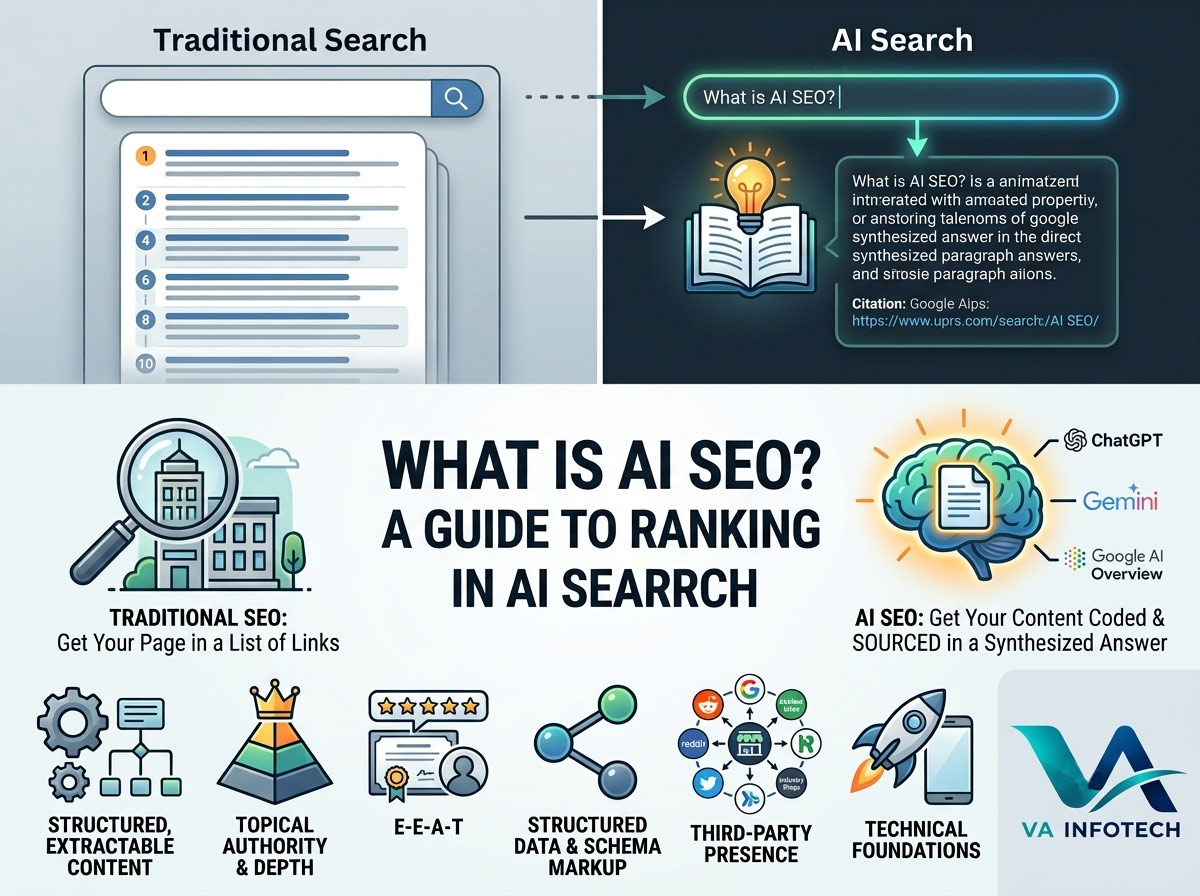
Search has quietly split into two different games. There’s still the familiar one — ten blue links, a search box, a scroll of results. And now there’s a second one running alongside it: a question typed into ChatGPT, Gemini, Perplexity, or Google’s AI Overview, and a single synthesized answer handed back, often with no click required at all. If your business isn’t showing up inside that answer, you’re invisible to a growing share of the people researching your product or service — even if you rank on page one of classic Google.
This is what “AI SEO” refers to, and it’s fast becoming as important as traditional SEO for any business that wants to stay discoverable. At VA Infotech, this is a big part of what we help clients navigate through our Large Language Model SEO service, so we wanted to put together a complete, practical guide to what AI SEO actually is, how it differs from traditional SEO, and what you can do today to start showing up in AI-generated answers.
What Is AI SEO?
AI SEO (also called Generative Engine Optimization, GEO, or LLM SEO) is the practice of optimizing your website and content so that AI systems — large language models like ChatGPT, Gemini, Claude, Perplexity, and Google’s AI Overviews — can find, understand, and cite your business when answering a user’s question.
Traditional SEO optimizes for ranking position: getting your page to show up as high as possible in a list of links. AI SEO optimizes for something different: getting your content selected, understood correctly, and referenced as a trustworthy source inside a generated answer. The user may never visit your website directly from that answer, but your brand still gets seen, and in many cases, the AI includes a link or citation back to you — which is often a more qualified, higher-intent visitor than one who clicked through ten search results first.
How AI Search Is Different From Traditional Search
Understanding the difference matters because the optimization playbook isn’t identical.
Traditional search (Google, Bing):
- Returns a ranked list of links based on hundreds of ranking signals — backlinks, keyword relevance, page speed, domain authority, and more.
- The user does the reading and comparing.
- Success is measured by ranking position and click-through rate.
AI search (ChatGPT, Gemini, Perplexity, AI Overviews):
- Returns a single synthesized answer, pulled and summarized from multiple sources.
- The AI does the reading and comparing, and decides which sources are credible enough to cite.
- Success is measured by whether your brand or content gets referenced, quoted, or recommended inside that answer at all.
This shift means AI systems care less about keyword density and backlink count, and much more about whether your content is clear, well-structured, factually accurate, and easy for a language model to extract and trust.
Why AI SEO Matters Right Now
A growing share of research-stage queries — “best CRM for small business,” “how does website hosting work,” “what should a landing page include” — are increasingly answered directly inside an AI chat interface or an AI Overview panel, without the user ever scrolling through traditional search results. For businesses that depend on organic search for leads, this isn’t a future trend to plan for later — it’s already reshaping how people find services today.
The businesses that adapt early get an outsized advantage, for a simple reason: AI models tend to repeatedly cite the same handful of sources they’ve learned to trust for a given topic. Being one of those early trusted sources compounds over time, much the way early backlink-rich sites dominated traditional SEO for years.
The Core Pillars of AI SEO
1. Structured, Extractable Content
AI models pull information more reliably from content that’s organized clearly — proper headings, short paragraphs, definition-style answers near the top of a section, and bullet points for lists or steps. A wall of unstructured text is much harder for a model to parse and confidently cite than a page with a clear H2 answering the exact question a user might ask.
A practical habit: for any important page, write a two-to-three sentence direct answer to the core question right under the heading, before going into detail. This single habit does more for AI visibility than almost anything else.
2. Topical Authority and Depth
AI systems favor sources that demonstrate real depth on a topic, not just a single thin page targeting one keyword. Building out a genuinely comprehensive content cluster — covering a topic from multiple angles, with internal links tying related pages together — signals the kind of authority a language model is more likely to trust and cite repeatedly. This is the same principle behind good search engine optimization content clusters, just applied with an AI reader in mind rather than only a human one.
3. E-E-A-T: Experience, Expertise, Authoritativeness, Trustworthiness
Google’s long-standing E-E-A-T framework matters even more in an AI-search world, because language models are explicitly trained to weigh source credibility when deciding what to cite. Author bios, clear business information, verifiable credentials, case studies, and original data all help establish the kind of trust signal that both traditional search rankings and AI citation systems reward.
4. Structured Data and Schema Markup
Schema markup (FAQ schema, Article schema, Organization schema, Product schema) gives AI crawlers a machine-readable layer of context about your content, making it easier for a model to correctly understand what your page is about and who’s behind it. This is a technical layer most businesses skip, and it’s one of the more overlooked levers in a proper SEO strategy today.
5. Being Present Where AI Models Learn
Large language models are trained and continually updated using a huge range of web sources — not just your own website, but also third-party platforms, review sites, forums, and industry directories. A business that only exists on its own website has a smaller footprint in the data these models draw from. Being cited, mentioned, or reviewed across multiple credible third-party sources increases the chance an AI model has encountered — and trusts — your brand when a relevant question comes up.
6. Fast, Crawlable, Mobile-Friendly Technical Foundations
None of the above matters if AI crawlers and search bots can’t efficiently access and render your site in the first place. A slow, poorly structured, or technically broken website limits both traditional and AI-driven visibility. This is why AI SEO isn’t a replacement for solid technical fundamentals — it builds directly on top of a well-built, well-maintained website design foundation.
AI SEO vs Traditional SEO: What Changes and What Stays the Same
It’s tempting to treat AI SEO as an entirely new discipline, but in practice, most of what makes a page rank well traditionally also makes it easier for an AI model to trust and extract. What genuinely changes is emphasis:
- Keywords still matter, but intent-matching matters more. Write to directly answer the question a real person would ask, not just to include a target phrase repeatedly.
- Backlinks still matter, but brand mentions matter almost as much. Even unlinked mentions of your business name across credible sites contribute to how AI models learn to associate your brand with a topic.
- Page speed and mobile usability still matter, since both traditional crawlers and AI-associated crawlers need to access your content efficiently.
- Content freshness matters more than ever, since AI models and their retrieval systems increasingly favor recently updated, accurate information over stale pages.
Common AI SEO Mistakes to Avoid
Even businesses actively working on AI SEO tend to trip on a few recurring mistakes:
- Writing for keywords instead of questions. Stuffing a target phrase into a paragraph reads poorly to a human and doesn’t help an AI model understand intent. Write the way you’d actually answer a customer on a call.
- Burying the answer. If a page takes three paragraphs of backstory before addressing the actual question, both readers and AI extraction systems lose patience. Lead with the answer, then explain.
- Ignoring third-party presence. A business that only publishes on its own domain has a much smaller footprint in the data AI models draw from than one that’s also referenced across directories, review platforms, and industry publications.
- Treating AI SEO as a one-time project. Content that isn’t reviewed and refreshed periodically loses relevance as AI models increasingly favor recently verified information.
- Skipping technical basics. No amount of well-written content helps if crawlers can’t render or access your pages efficiently in the first place.
A Practical AI SEO Checklist
- Audit your top pages and rewrite key sections to lead with a direct, clear answer near the top.
- Add FAQ sections with real, specific questions your customers actually ask — and mark them up with FAQ schema.
- Build topic clusters instead of isolated blog posts, linking related content together.
- Strengthen author and business credibility signals: bios, credentials, verifiable contact information, case studies.
- Get listed, reviewed, or mentioned on credible third-party sites relevant to your industry.
- Keep cornerstone content updated regularly rather than publishing once and forgetting it.
- Fix technical basics — page speed, mobile rendering, clean site structure — so both traditional and AI crawlers can access everything without friction.
- Track brand mentions across AI platforms periodically by asking ChatGPT, Gemini, and Perplexity questions relevant to your industry and seeing whether — and how — you’re cited.
How VA Infotech Can Help
AI SEO isn’t something you bolt onto a website as an afterthought — it works best when it’s built into your broader digital strategy alongside traditional search engine optimization, a well-structured website design, and consistent digital marketing and social media marketing that build the kind of cross-platform presence AI models learn to trust. For businesses running paid channels alongside organic growth, our PPC setup and marketing service can complement AI-search visibility while your organic AI SEO presence builds over time.
At VA Infotech, our dedicated Large Language Model SEO service is built specifically to help businesses get found, understood, and cited correctly inside AI-generated answers — from technical schema implementation to content restructuring and cross-platform authority building.
Frequently Asked Questions
Is AI SEO replacing traditional SEO? No. AI SEO builds on the same foundations as traditional SEO — quality content, technical performance, credibility signals — but adds an additional layer focused on how language models extract, understand, and cite information.
How long does it take to see results from AI SEO? Similar to traditional SEO, AI SEO is a compounding effort. Structural and content changes can influence AI citations within weeks for some queries, but building durable topical authority typically takes several months of consistent work.
Can small businesses realistically compete for AI search visibility? Yes. Because AI models value clarity, structure, and genuine expertise over sheer domain size, a well-optimized small business page can outperform a much larger, poorly structured competitor for specific, well-targeted queries.
Do I need schema markup for AI SEO to work? Schema markup isn’t strictly mandatory, but it significantly helps AI crawlers correctly interpret your content, and it’s one of the highest-leverage technical steps a business can take.
Get Started With AI SEO
AI search is no longer an emerging trend — it’s already shaping how a growing share of your potential customers find and evaluate businesses like yours. Getting your content structured, credible, and visible to AI systems now puts you ahead of competitors who are still optimizing purely for the old rules of search. Get in touch with VA Infotech to see how our Large Language Model SEO and SEO services can help your business start ranking in AI search results.