
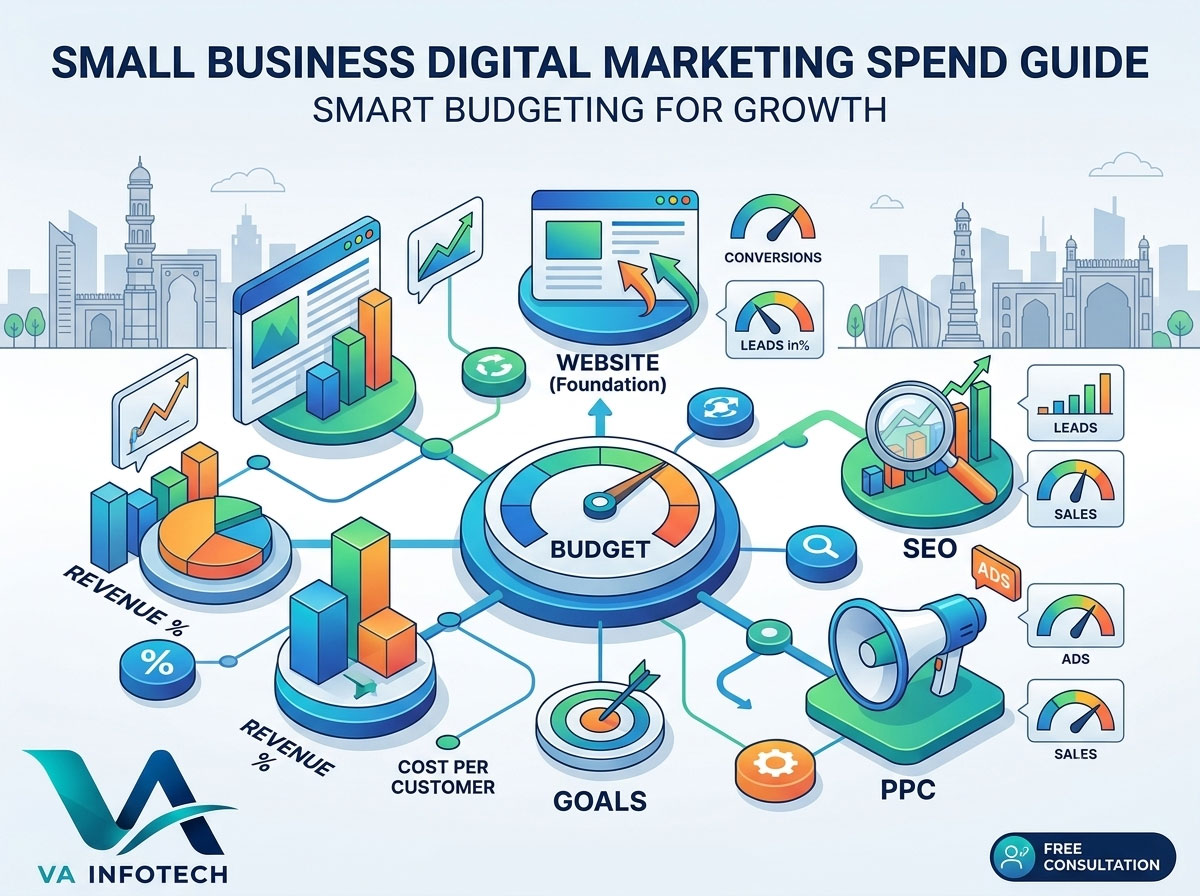
Every small business owner eventually asks the same question: how much should I actually spend on digital marketing? Spend too little and nobody finds you. Spend too much without a plan and you burn cash on ads and tools that never bring a single customer.
The honest answer is that there is no single number that fits every business. But there are reliable benchmarks, clear ways to split your budget across channels, and simple methods to check whether your money is working. In this guide, Va Infotech breaks down how to set a small business digital marketing budget that matches your goals, your stage of growth and your industry.
Why Your Digital Marketing Budget Matters
Most of your customers start their buying journey online. They search on Google, compare options on Maps, read reviews, check your website and look at your social media before they call. If you are missing from any of those places, a competitor gets the enquiry instead.
A defined budget does three things for you:
- It forces clear priorities. You choose the channels that suit your business instead of trying everything at once.
- It makes results measurable. When you know what you spent and what came back, you can improve month after month.
- It protects your cash flow. A planned budget stops random, emotional spending on the latest trend.
Digital marketing is not an expense to minimize. It is a growth investment, and like any investment it needs a target, a timeline and regular review.
The Common Budget Benchmarks
Start with these commonly used rules of thumb. Treat them as a starting point, not a rule.
1. Percentage of revenue
Many small businesses set their total marketing budget between 5% and 12% of annual revenue. Within that, the digital share usually grows every year as more buying moves online.
- Established business, steady sales (about 5% to 8%): You mainly need to maintain your position and keep leads flowing.
- Growing business (about 8% to 12%): You are pushing into new customers, cities or services.
- New business or aggressive growth (10% to 20%): You need to build awareness and a customer base from zero, so higher spend is normal at first.
For example, if your business earns ₹50 lakh a year and you decide on 8%, your total marketing budget is ₹4 lakh a year, or roughly ₹33,000 a month. Not all of it needs to be digital, but for most small businesses today, the majority should be.
2. Cost per customer method
Work backwards from what a customer is worth to you.
- Find your average profit per customer (or per sale).
- Decide how much of that you can afford to spend to win one customer.
- Estimate how many customers you want per month.
- Multiply the two numbers.
If a customer is worth ₹10,000 in profit and you are happy to spend ₹2,000 to win one, then aiming for 15 new customers a month means a monthly budget of about ₹30,000. This method ties spending directly to results and works well for service businesses.
3. Goal-based budgeting
Set a specific target first, such as “40 qualified enquiries a month” or “a 30% increase in online orders”. Then research what it costs to reach that goal on each channel. This is the most accurate method, but it needs some data, so it works best after a few months of activity.
What Affects How Much You Should Spend
Two businesses with the same revenue can need very different budgets. Consider these factors.
Your industry and competition. Keywords in legal, real estate, healthcare and education cost far more than those for a local bakery. The more competitors bidding and ranking, the more it takes to be seen.
Your business stage. A new business has no reviews, no website authority and no audience. It usually needs more spend early on.
Your goals. Brand awareness, lead generation and online sales each need different channels and different budgets.
Your current assets. A fast, well-built website with existing content and reviews needs less investment than one that must be rebuilt first.
Your location. Targeting one city costs much less than targeting the whole country. Local campaigns are often the best value for small businesses.
In-house or agency. Hiring even one full-time marketer can cost more than outsourcing to a specialist team that brings design, SEO, ads and reporting together.
How to Split Your Digital Marketing Budget by Channel
Here is a sensible starting split for a small business with a combined budget of ₹30,000 to ₹60,000 a month. Adjust the percentages to fit your goals.
| Channel | Suggested share | Best for |
|---|---|---|
| Website and conversion improvements | 10% to 20% | Turning visitors into enquiries |
| SEO (including local SEO) | 25% to 35% | Long-term, low-cost lead flow |
| PPC / paid ads | 20% to 30% | Fast leads and testing offers |
| Social media marketing | 10% to 20% | Brand building and engagement |
| Content and email | 5% to 10% | Nurturing and repeat business |
| Tools and reporting | 3% to 5% | Tracking what works |
Let’s look at each channel in more detail.
Your website: the foundation
Every other channel sends people to your website. If it is slow, outdated or hard to use on mobile, the rest of your budget leaks away. Before you spend on ads or SEO, make sure your site loads fast, looks trustworthy and makes it easy to call, book or buy.
If your site needs work, professional Website Design is often the smartest first investment. For online sellers, dedicated eCommerce Website Design makes browsing, checkout and payments smooth. And if your current site is simply not performing, a Website Redesign can fix conversion problems without starting from scratch on your brand.
Once the site is live, keep it healthy with regular Website Maintenance covering updates, security, backups and speed. Reliable Web Hosting also affects load time and uptime, both of which affect sales and rankings.
SEO: your best long-term return
Search Engine Optimization takes a few months to build, but the results keep growing and you do not pay for each click. For most small businesses, SEO becomes the cheapest source of leads over time.
A good Search Engine Optimization plan covers technical fixes, on-page optimization, content and link building. To start on the right foot, learn how to find high-value keywords for your business so you target searches that actually lead to sales. It also helps to run through this complete SEO audit checklist for business websites to catch problems that hold your rankings back.
Search is also changing. People now ask AI tools for recommendations, so it is worth preparing your content for them too. Our Large Language Model SEO service helps businesses appear in AI-generated answers as well as traditional search results.
Local SEO deserves special attention. If you serve customers in a specific area, your Google Business Profile can send you calls and visits at very little cost. Follow our local SEO checklist for businesses in India, and read the guides on how to optimize your Google Business Profile for more customers and the complete Google Business Profile SEO optimization guide.
PPC: fast results with control
Pay-per-click advertising on Google or social platforms brings leads quickly. You choose your daily budget, your audience and your message, and you can stop at any time. That makes it ideal for testing offers, launching new services or filling gaps while SEO builds.
The key is setup. Poor targeting, weak ad copy and a landing page that does not convert waste money quickly. Professional PPC Setup and Marketing ensures your budget goes to the right keywords, audiences and landing pages from day one.
A practical tip: start with a small daily budget, find the ads and keywords that bring real enquiries, and only then increase spend.
Social media: build trust and visibility
Social platforms help customers get to know your brand, see your work and hear from other customers. They also keep you in front of people who are not searching yet but will need you soon.
You do not need to be on every platform. Choose the two or three where your customers actually spend time and post consistently. Professional Social Media Marketing covers content planning, design, community management and paid social campaigns.
Content and email: nurture what you earn
Blogs, guides, case studies and email newsletters answer customer questions, build authority and bring people back. They also support your SEO. Even a monthly newsletter and two blog posts a month can outperform expensive one-off campaigns.
Bringing it together
Running each channel separately often leads to mixed messages and wasted effort. A joined-up Digital Marketing strategy makes your website, SEO, ads and social media work as one system, with shared goals and reporting.
If you want to show customers your premises or products in a more engaging way, a Virtual Tour can also help you stand out from competitors, especially for hotels, showrooms, restaurants and real estate.
Sample Monthly Budgets by Business Stage
These are illustrative examples for planning. Actual costs vary by industry, competition and agency.
Starter budget: about ₹15,000 to ₹30,000 a month Best for very small or new businesses on a tight budget. Focus on your Google Business Profile, basic on-page SEO, one social platform and a small test ad budget. Do as much yourself as you comfortably can.
Growth budget: about ₹30,000 to ₹75,000 a month Best for businesses with steady sales that want more leads. Combine ongoing SEO, monthly content, a managed PPC campaign and consistent social media, with monthly reporting.
Scale budget: ₹75,000 and above a month Best for businesses expanding into new cities or product lines. Add larger ad spend, conversion optimization, email automation, video and more content.
Remember that ad spend paid directly to platforms (like Google) is separate from the fees you pay an agency to manage your campaigns.
Where Small Businesses Waste Money
Avoid these common mistakes:
- Advertising to a weak website. Fix the site before you buy traffic.
- Spreading a small budget too thin. Three channels done well beat seven done badly.
- Chasing quick fixes. Shortcuts like fake reviews or bought links risk penalties.
- Not tracking results. If you cannot see calls, forms and sales by channel, you cannot improve.
- Stopping too early. SEO and content need several months to show their full effect.
- Cutting the budget during slow months. Competitors who keep marketing capture the customers you leave behind.
- Ignoring existing customers. Repeat business and referrals are cheaper than new customers.
How to Know if Your Spend Is Working
Track these numbers every month:
- Leads or enquiries from each channel
- Cost per lead (total spend divided by leads)
- Cost per customer (total spend divided by paying customers)
- Conversion rate of your website and landing pages
- Return on ad spend (ROAS) for paid campaigns
- Organic traffic and keyword rankings for SEO progress
- Customer lifetime value compared with acquisition cost
If a channel brings customers at a cost you can afford, put more into it. If not, adjust the message, the audience or the landing page before you cut it. Give each channel a fair test period, usually three to six months for SEO and four to eight weeks for paid ads.
A Simple 5-Step Plan to Set Your Budget
- Set a clear goal. For example, “30 new enquiries a month within six months”.
- Pick your budget method. Percentage of revenue, cost per customer or goal-based.
- Choose two or three priority channels. Start where your customers already search.
- Split the budget and set review dates. Check performance every month and adjust every quarter.
- Get expert help where it saves money. A specialist team often gets better results per rupee than trial and error.
Should You Hire an Agency?
If you have the time and skill to learn SEO, ads, design and analytics, you can handle some tasks yourself. But most owners are better off spending time on their business and leaving marketing to specialists. An agency brings a full team, established tools and experience from many industries, often at a lower cost than a single full-time hire.
When you choose a partner, look for clear reporting, honest timelines, relevant case studies and a strategy built around your goals instead of a generic package. You can browse our Portfolio to see the kind of work we deliver, and learn more about our team on the About Us page.
Frequently Asked Questions
What percentage of revenue should a small business spend on digital marketing? Most small businesses allocate roughly 5% to 12% of revenue to total marketing, with newer or fast-growing businesses spending more. The digital share should be the largest part of that for most businesses.
How much should a small business spend on SEO each month? It depends on competition, location and goals. Local businesses in low-competition areas can start at a modest monthly budget, while competitive industries and national targeting need more. SEO is a long-term investment, so plan for at least six months.
Is PPC or SEO better for a small business? They serve different purposes. PPC gives fast leads and quick testing, while SEO builds lasting visibility at a lower cost per lead over time. Many small businesses use PPC to get early results while SEO grows.
Can I run digital marketing on a very small budget? Yes. Start with a fully optimized Google Business Profile, a mobile-friendly website, a few well-chosen keywords and one social media channel. Add paid ads as you see returns.
How long before I see results? Paid ads can bring enquiries within days. Social media and content usually take a few months. SEO commonly shows meaningful growth in three to six months, depending on competition.
Should I increase my budget during slow seasons? Often, yes, or at least keep it steady. Competitors who reduce spend lose visibility, and consistent marketing during quiet periods helps you gain market share.
Final Thoughts
There is no perfect number for a small business digital marketing budget, but there is a right approach: set a clear goal, choose a realistic percentage of revenue, invest first in a strong website, focus on a few high-value channels and measure everything. Review your results monthly and reinvest in what works.
At Va Infotech, we help small businesses in Ahmedabad and across India build marketing plans that fit their budget, from website design and SEO to PPC, social media and complete digital marketing strategy. If you are unsure how much to spend or where to start, our team can review your current setup and suggest a practical plan.
Ready to plan your budget? Visit vainfotech.com, explore our Services, read more helpful guides on our Blog, or contact us for a free consultation.