
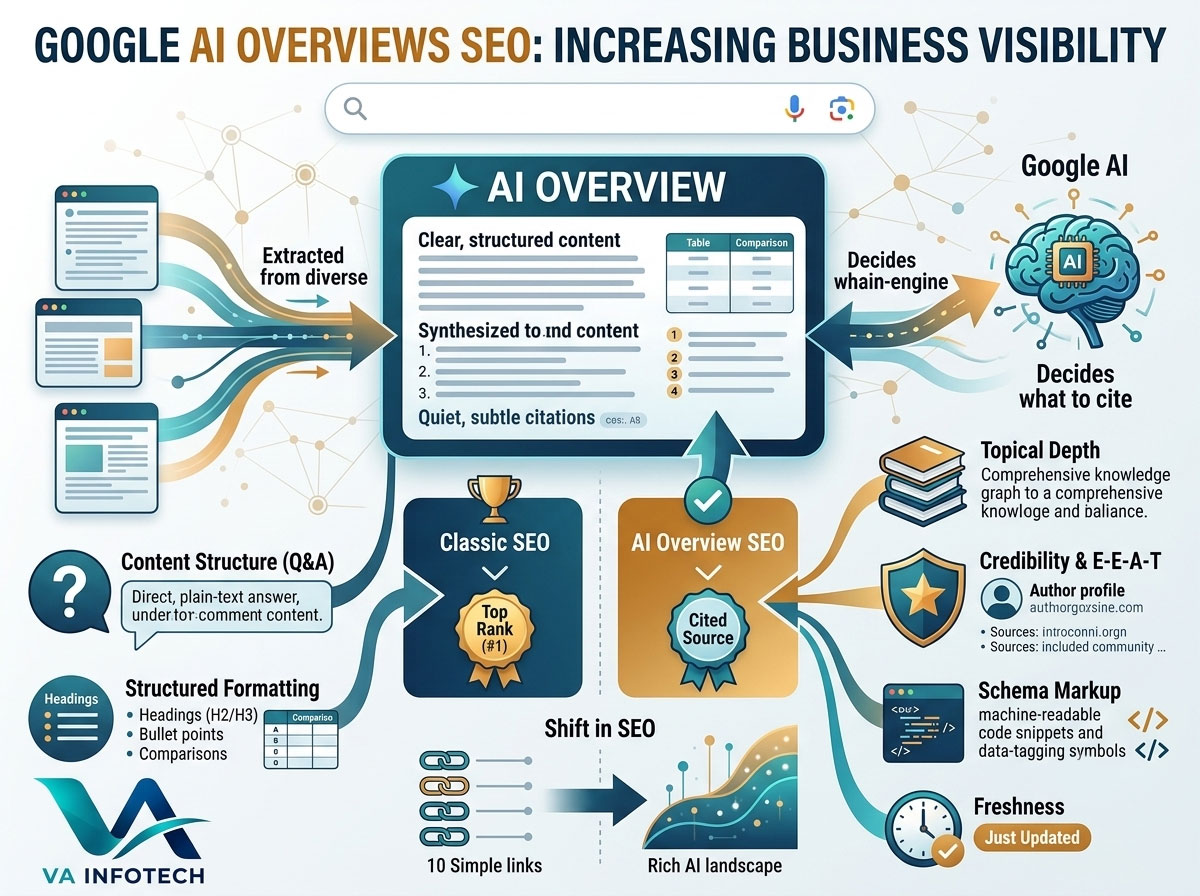
Type almost any question into Google today and there’s a good chance you won’t see ten blue links first — you’ll see an AI-generated summary sitting above them, with a handful of sources quietly credited underneath. That’s Google AI Overviews, and it’s quickly become one of the biggest shifts in how people find businesses online since Google itself launched.
For years, the SEO conversation was about rankings: get to position one, and the traffic follows. AI Overviews break that logic. A page sitting at position eight can get cited inside an Overview while the page at position one gets skipped entirely. Visibility no longer depends only on where you rank — it depends on whether Google’s AI considers your content clear, structured, and trustworthy enough to summarize and credit.
This guide breaks down what AI Overviews actually are, how they decide what to cite, and the specific, practical steps a business can take to show up inside them — not just below them.
What Are Google AI Overviews, Exactly?
AI Overviews are AI-generated summaries that Google displays at the top of relevant search results, synthesizing information from multiple web sources into a single written answer. Instead of sending a searcher straight to a list of pages to click through and compare themselves, Google is doing a first pass of that research for them — then linking out to the sources it pulled from.
They show up most often for informational queries: “how does X work,” “what’s the difference between X and Y,” “best way to do X.” Transactional and highly local queries still lean more on traditional results and Google Business Profiles, but that line is shifting quickly as the feature expands into more search categories.
The important distinction from classic SEO: AI Overviews don’t just rank a page, they extract from it. A page can be well-optimized for keywords and still get skipped by an Overview if its content isn’t structured in a way that’s easy to lift a clean, self-contained answer from.
Why This Matters More Than It Might Seem
A citation inside an AI Overview tends to carry outsized trust. The searcher isn’t scanning ten options and deciding for themselves who looks credible — Google has already done that filtering, and your business is one of a small number named. That’s a very different kind of visibility than a ranking position, and it converts differently too: by the time someone clicks through from a citation, they’ve already effectively been pre-sold.
The businesses treating this as “just another algorithm update” are going to fall behind the ones treating it as a new visibility channel worth optimizing for directly — the same way businesses that took technical SEO seriously years ago outran competitors who didn’t.
How Google AI Overviews Actually Select Sources
Understanding the mechanics changes how you write for them. A few patterns consistently show up in what gets cited:
1. Content that directly answers a specific question. Overviews favor pages built around a clear question-and-answer structure over pages that bury the answer three paragraphs into a narrative introduction. If someone could ask your page a question and get a clean, standalone answer within a sentence or two, that section is a strong citation candidate.
2. Structured, scannable formatting. Headings, numbered steps, comparison tables, and bullet lists are easier for an AI system to extract cleanly than dense paragraphs. This is part of why a solid content structure has become as important as the words themselves.
3. Topical depth, not just keyword density. AI Overviews tend to pull from pages that cover a topic comprehensively — the same content that also tends to answer several related questions, not just the one that was typed in. A single well-developed page usually outperforms five thin ones targeting slight variations of the same query.
4. Credible, well-structured sources. Authoritativeness still matters, but it’s less about raw domain age and more about whether the page’s information is clear, accurate, and consistent with how the topic is described elsewhere. Structured data (schema markup) plays a growing role here, since it gives Google an explicit, machine-readable signal about what a page is actually saying.
5. Freshness on time-sensitive topics. For anything involving pricing, statistics, tools, or “in 2026” type framing, recently updated content is favored over content that’s technically still accurate but visibly stale.
Practical Steps to Increase Your AI Overview Visibility
1. Restructure Content Around Direct Answers
Every important page should have at least one section — often the opening paragraph or a dedicated subheading — that answers the core question in two or three plain sentences, before you go into detail. Think of it as writing the summary Google would want to lift, and then expanding on it for human readers underneath. This doesn’t mean dumbing content down; it means putting the conclusion first instead of building up to it.
2. Use Clear Heading Structure and Formatting
Break content into logical H2/H3 sections that each answer one sub-question. Use numbered steps for processes, bullet points for lists of options or features, and comparison tables wherever you’re weighing trade-offs — the kind of structure we used in our own breakdown of custom website development vs. website builders, which makes it far easier for both readers and AI systems to extract the exact section they need.
3. Add Structured Data (Schema Markup)
FAQ schema, Article schema, and Organization schema all give Google explicit signals about your content instead of forcing it to infer structure from raw HTML. This is one of the more technical levers in AI Overview optimization, and it’s worth pairing with a proper technical SEO audit to make sure your site’s foundation supports it correctly.
4. Build Topical Depth, Not Just More Pages
Instead of publishing five shallow posts targeting near-identical keywords, build fewer, deeper resources that thoroughly answer a topic and its related questions. Internal linking between these resources also helps Google understand the full scope of what you cover — which is part of why a consistent SEO strategy, rather than one-off posts, tends to compound over time.
5. Strengthen E-E-A-T Signals
Experience, Expertise, Authoritativeness, and Trustworthiness remain foundational — AI Overviews still lean on the same underlying quality signals Google has used for years. Author bylines, clear business information, cited data, and consistent NAP (name, address, phone) details across the web all contribute. This overlaps directly with Google Business Profile optimization, which remains one of the fastest ways to strengthen local trust signals.
6. Optimize for Page Speed and Core Web Vitals
Google has been clear that page experience remains part of its broader ranking systems, and a slow, bloated page is less likely to be prioritized for crawling and citation in the first place. If your site is built on a platform that’s hitting a performance ceiling, it may be time to revisit whether your current setup — covered in our comparison of custom development vs. website builders — is still serving you well.
7. Get Cited Elsewhere, Not Just Ranked
AI Overviews often draw on a wider pool of sources than the traditional top ten results — meaning a page doesn’t have to win position one to get cited, but it does need to be found somewhere credible. Digital PR, guest contributions, directory listings, and consistent brand mentions across the web all increase the surface area where Google’s systems can pick you up. This is a natural extension of a broader digital marketing strategy rather than an isolated SEO tactic.
8. Treat This as Part of a Broader AI Search Shift
Google AI Overviews are one piece of a larger change — search behavior is also moving toward tools like ChatGPT and Perplexity, which pull from a different but overlapping set of signals. Businesses optimizing purely for classic Google rankings while ignoring this broader shift are optimizing for a shrinking slice of how people actually search now. We go deeper into this in our guide on getting your business mentioned in AI search results, and offer dedicated Large Language Model SEO support for businesses that want a strategy built around this shift specifically, rather than bolted onto old-school SEO.
9. Audit and Update Existing Content Regularly
Content that was accurate and well-optimized two years ago may now be missing the structure, freshness, or depth that AI Overviews favor. Running your top-performing pages through a proper SEO audit checklist periodically — rather than only auditing when rankings visibly drop — keeps your best content eligible for citation as the standards shift.
What This Looks Like for Different Types of Businesses
A local service business benefits most from tightening Google Business Profile signals, consistent local citations, and FAQ-structured content answering the specific questions customers ask before hiring someone in that category.
A B2B or SaaS business benefits most from deep, well-structured resource content — comparison pages, “how X works” explainers, and data-backed guides — since these are exactly the query types where AI Overviews appear most often.
An e-commerce business benefits from structured product data, clear comparison content between products or categories, and FAQ schema on category and product pages, since AI Overviews increasingly surface for “best X for Y” style shopping research queries.
If your current site’s structure makes any of this difficult — say, you’re on a platform with limited control over schema, page structure, or technical SEO — that’s often a sign the underlying platform has become the bottleneck rather than the content strategy itself.
The Bottom Line
Google AI Overviews reward the same fundamentals good SEO always has — clear answers, credible sources, solid technical foundations — but they raise the bar on structure and extractability specifically. The businesses that adapt their content to be directly citable, rather than just rankable, are the ones that will keep showing up as more of search shifts toward AI-generated answers.
This isn’t a one-time fix; it’s an ongoing discipline, similar to how a website itself needs periodic reassessment rather than a single redesign. If you’re not sure whether your current site and content are positioned for this shift, our SEO and Large Language Model SEO teams at Va Infotech can audit where you stand and build a plan around it — get in touch or explore our full range of services.