
Every business owner eventually asks the same question: “Is my digital marketing actually making me money?”
You pay for SEO, run Google Ads, post on social media, and maybe send email campaigns. The invoices arrive every month, but the returns are harder to see. Without a clear way to measure digital marketing ROI, you are guessing, and guessing is expensive.
This guide explains how to calculate digital marketing ROI for your business, which numbers to track, which mistakes to avoid, and how to turn the results into better decisions. Whether you run a local service company, an online store, or a B2B firm, the same principles apply.
What Is Digital Marketing ROI?
ROI stands for return on investment. In digital marketing, it measures how much revenue or profit your campaigns generate compared with what you spent on them.
If you spend ₹1,00,000 on marketing and it brings ₹3,00,000 in revenue, you have a clear picture of what that money did. If you cannot connect your spend to your results, you cannot decide where to invest more or what to cut.
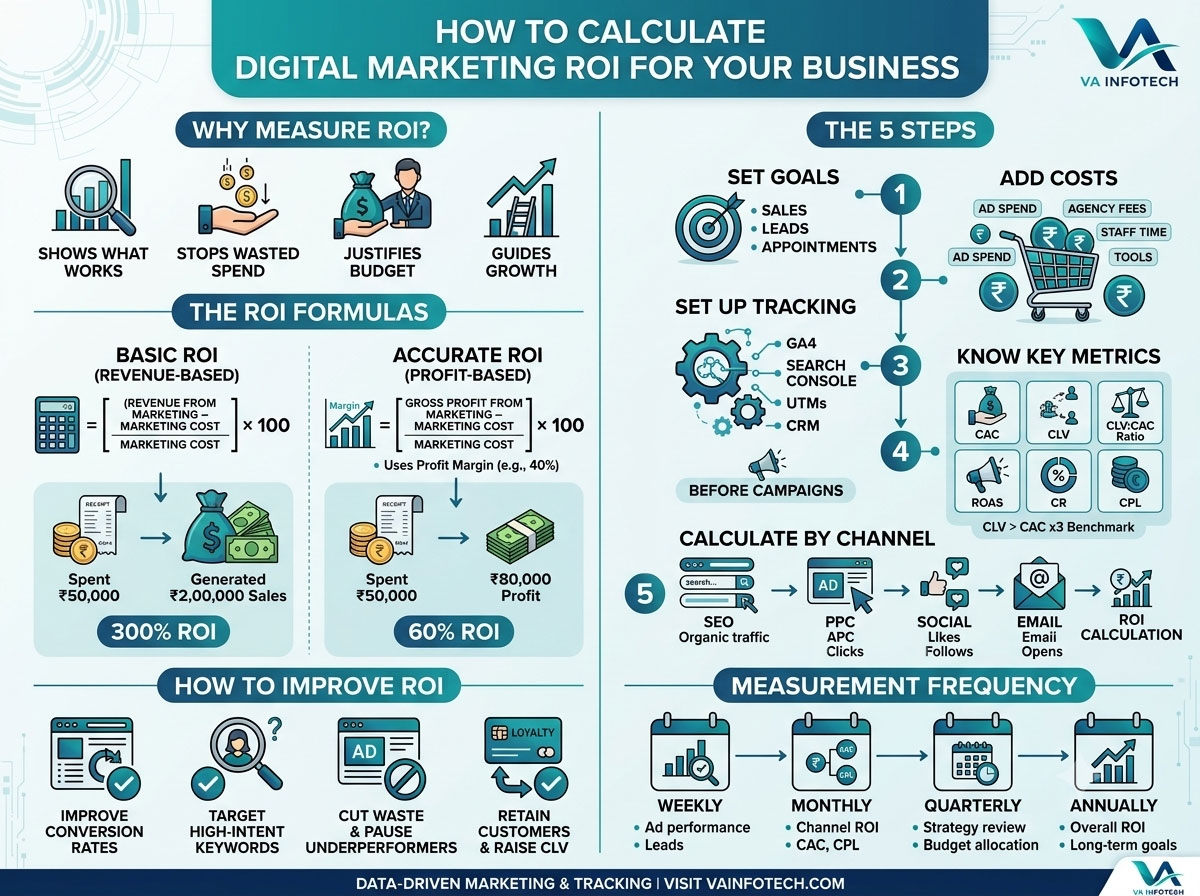
Calculating ROI matters for four reasons:
- It shows what works. Some channels will outperform others, and the data tells you which.
- It stops wasted spend. Underperforming campaigns can be fixed or paused.
- It justifies your budget. Clear numbers make it easier to defend marketing spend to partners, managers, or investors.
- It guides growth. You can scale the channels that already deliver.
If you are still working out how much to spend, read our guide on how much a small business should spend on digital marketing. Once your budget is set, ROI tells you whether it is working.
The Basic Digital Marketing ROI Formula
The standard formula is:
ROI (%) = (Revenue from Marketing − Marketing Cost) ÷ Marketing Cost × 100
Example: You spend ₹50,000 on a campaign and it generates ₹2,00,000 in sales.
- Revenue minus cost = ₹1,50,000
- ₹1,50,000 ÷ ₹50,000 = 3
- 3 × 100 = 300% ROI
For every ₹1 invested, you earned ₹3 in profit above your cost.
This version uses revenue. A more accurate version uses profit, because revenue ignores the cost of delivering your product or service:
ROI (%) = (Gross Profit from Marketing − Marketing Cost) ÷ Marketing Cost × 100
If your products carry a 40% margin, the same ₹2,00,000 in sales produces ₹80,000 in gross profit. After the ₹50,000 spend, you have ₹30,000 left, which is a 60% ROI. That is a very different story from 300%, which is why serious marketers track profit-based ROI wherever possible.
Step 1: Set Clear, Measurable Goals
You cannot calculate ROI without knowing what “return” means for your business. Define it before you spend.
Common goals include:
- Online sales or revenue
- Qualified leads or enquiries
- Booked appointments or consultations
- Phone calls and form submissions
- Newsletter or demo sign-ups
Make each goal specific. “Get more traffic” is not a goal. “Generate 40 qualified leads per month at a cost below ₹1,500 each” is. Specific targets give you a benchmark to measure against.
Step 2: Add Up Your Total Marketing Costs
Many businesses underestimate cost, which inflates their ROI on paper. Include everything:
- Ad spend: Google Ads, Meta Ads, LinkedIn Ads
- Agency or freelancer fees: retainers, project fees, consulting
- Software and tools: analytics, CRM, email platforms, SEO tools
- Content costs: writing, design, photography, video
- Staff time: salaries or hours spent managing campaigns
- Website costs: hosting, maintenance, landing page development
A full cost picture keeps your ROI honest. If your website is slow or outdated, it can also quietly drag down every channel’s results, so ongoing website maintenance belongs in the conversation.
Step 3: Set Up Tracking Before You Need It
Accurate ROI depends on accurate data. Set up these foundations first:
Google Analytics 4 (GA4). Track sessions, sources, and user behavior. Configure conversion events for form fills, calls, purchases, and key button clicks.
Google Search Console. See which queries and pages bring organic traffic and how they perform in search.
Conversion tracking on ad platforms. Connect Google Ads and Meta Ads so they report real conversions, not just clicks.
UTM parameters. Add UTM tags to campaign links so you know exactly which email, ad, or social post produced each visit.
Call tracking and CRM. For lead-based businesses, many sales happen offline. A CRM lets you tie a closed deal back to the campaign that started it.
Skipping this step is the most common reason ROI numbers turn out unreliable. If you want help getting your measurement stack right, our digital marketing services include tracking and reporting built around your goals.
Step 4: Know the Key Metrics Behind ROI
ROI is the headline number, but several supporting metrics explain why it is high or low.
Customer Acquisition Cost (CAC)
CAC is how much you spend to win one customer.
CAC = Total Marketing Cost ÷ Number of New Customers
If you spend ₹1,00,000 and gain 20 customers, your CAC is ₹5,000.
Customer Lifetime Value (CLV)
CLV estimates the total revenue or profit one customer brings over the entire relationship.
CLV = Average Order Value × Purchase Frequency × Customer Lifespan
A customer who spends ₹3,000 per order, buys four times a year, and stays for three years is worth ₹36,000 in revenue.
The CLV to CAC Ratio
Comparing these two numbers reveals the real health of your marketing. A common benchmark is a CLV that is at least three times your CAC. If your CAC is ₹5,000 and your CLV is ₹36,000, you have plenty of room to invest.
This is why a campaign that looks unprofitable on the first sale can still be a winner. If customers come back, the long-term return is much higher than the first purchase suggests.
Return on Ad Spend (ROAS)
ROAS measures revenue earned per rupee of ad spend.
ROAS = Revenue from Ads ÷ Ad Spend
If ₹40,000 in ads produces ₹1,60,000 in revenue, your ROAS is 4. ROAS is useful for paid channels, but it ignores profit margin and non-ad costs, so use it alongside ROI rather than instead of it.
Conversion Rate
Conversion Rate = Conversions ÷ Visitors × 100
If 2,000 visitors produce 60 enquiries, your conversion rate is 3%. Improving conversion rate raises ROI without raising your spend.
Cost Per Lead (CPL)
CPL = Marketing Cost ÷ Number of Leads
CPL is vital for service businesses. Pair it with your lead-to-customer close rate to see what a lead is truly worth.
Step 5: Calculate ROI for Each Channel Separately
A single blended ROI number hides the truth. One channel may be carrying the others. Calculate each channel on its own.
Search Engine Optimization (SEO)
SEO takes longer to pay off, but its returns compound. Track:
- Organic traffic growth
- Keyword rankings for commercial terms
- Organic leads and sales
- Cost per organic lead over time
To estimate SEO ROI, divide the revenue from organic visitors by your SEO investment. Because a ranking page keeps producing traffic without paying per click, long-term SEO ROI is often strong. Our search engine optimization service focuses on exactly these revenue-linked outcomes. A solid foundation like keyword mapping also improves returns by making sure every page targets the right search intent.
Pay-Per-Click Advertising (PPC)
PPC is the easiest channel to measure because the cost and the conversions are both visible. Track:
- Cost per click and click-through rate
- Conversion rate and cost per conversion
- ROAS and profit per campaign
If PPC campaigns burn money on irrelevant clicks, the fix is usually better keyword targeting, negative keywords, and stronger landing pages. See how our PPC setup and marketing service structures campaigns to cut wasted spend.
Social Media Marketing
Social ROI is trickier because it often works earlier in the buying journey. Track:
- Reach and engagement
- Traffic and leads from social posts and ads
- Social-assisted conversions in GA4
Not every social benefit is directly measurable in rupees, but link clicks, enquiries, and assisted conversions give you real numbers. Explore our social media marketing service for campaigns tied to measurable outcomes.
Email Marketing
Email usually delivers a high return because you are talking to people who already know you. Track open rate, click rate, and revenue per email sent.
Local and Google Business Profile Marketing
If you serve a specific area, calls, direction requests, and form fills from your listing are direct returns. Learn how to grow them in our guide on getting more local leads from Google search.
Your Website and Landing Pages
Every channel sends traffic to your website, so its quality sets the ceiling on your ROI. A confusing layout, slow load times, or a weak checkout will waste good traffic. Understanding the difference between UX and UI helps you spot what is holding conversions back. If you run an online store, optimizing your product pages for Google lifts both traffic and sales, and a professionally built eCommerce website supports every campaign you run.
A Worked Example
Let’s put the steps together with a fictional local service company.
Monthly marketing costs
- Google Ads: ₹40,000
- SEO and content: ₹30,000
- Social media ads: ₹15,000
- Tools and reporting: ₹5,000
- Total: ₹90,000
Monthly results
- 90 leads in total
- 27 became paying customers (30% close rate)
- Average first-job value: ₹15,000
- Revenue: 27 × ₹15,000 = ₹4,05,000
- Gross profit at a 45% margin: ₹1,82,250
Calculations
- ROI (profit-based) = (₹1,82,250 − ₹90,000) ÷ ₹90,000 × 100 = about 102%
- CAC = ₹90,000 ÷ 27 = ₹3,333
- CPL = ₹90,000 ÷ 90 = ₹1,000
Now look at the channels separately. Suppose Google Ads produced 40 leads (CPL ₹1,000), SEO produced 35 leads (CPL ₹857), and social produced 15 leads (CPL ₹1,000). Once you see which channel produced more closed customers, you can shift budget toward the winners.
If those customers also return for repeat work, CLV pushes the true ROI far higher than the first-job figure.
Attribution: Giving Credit Where It Is Due
A customer might find you through an Instagram post, search your brand on Google two days later, then click a retargeting ad before buying. Which channel gets the credit?
That is the attribution question. Common models include:
- Last-click: all credit to the final touchpoint
- First-click: all credit to the first touchpoint
- Linear: credit split evenly
- Data-driven: credit assigned by algorithms based on actual behavior
No model is perfect. The practical approach is to look at both direct and assisted conversions, and avoid cutting a channel just because it rarely gets last-click credit. Top-of-funnel content and awareness work often looks weak under last-click models while quietly feeding everything else.
Why ROI Calculations Go Wrong
Watch for these common mistakes:
- Ignoring hidden costs. Staff time, tools, and creative work all count.
- Judging too early. SEO and content marketing take months to build momentum. Evaluate them over a longer window than ads.
- Measuring clicks instead of customers. Traffic and likes are not revenue.
- Skipping offline conversions. Calls and walk-ins that started online still count.
- Using revenue instead of profit. A high-revenue campaign can still lose money.
- Ignoring lifetime value. Judging only the first sale undervalues repeat customers.
- No baseline. Without before-and-after data, you cannot say what changed.
How to Improve Your Digital Marketing ROI
Once you can measure ROI, you can raise it. The ROI equation has two levers: increase the return, or reduce the cost.
Improve conversion rates. Better headlines, clearer calls to action, faster pages, and simpler forms turn more of your existing traffic into customers. If your site is the bottleneck, a website redesign or a better-structured website design can lift every channel at once.
Target high-intent keywords. Searches that signal buying intent convert better than broad informational ones. Match each page to the right query and your cost per lead falls.
Prepare for AI-driven search. Search is changing, and visibility now includes AI answers. Our guide to Google AI Overviews SEO explains how to stay visible, and our Large Language Model SEO service helps your brand appear in AI-generated answers too.
Cut waste. Pause ads that burn budget without conversions, remove low-value keywords, and consolidate overlapping efforts.
Retain customers. Repeat buyers cost far less than new ones. Email follow-ups, loyalty offers, and good service raise CLV.
Protect your digital assets. A hacked or broken site wipes out marketing returns overnight. A sound website backup strategy protects the investment behind your campaigns.
Test continuously. A/B test headlines, offers, landing pages, and ad copy. Small gains compound.
How Often Should You Measure ROI?
- Weekly: ad performance, lead volume, and anything spending money quickly
- Monthly: channel-level ROI, CPL, CAC, and conversion rates
- Quarterly: budget allocation, SEO progress, and strategy review
- Annually: overall marketing ROI, CLV trends, and goal setting
Consistent reporting matters more than perfect reporting. A simple dashboard reviewed every month beats a complex one nobody opens.
What Is a Good Digital Marketing ROI?
There is no universal number. A commonly cited rule of thumb is a 5:1 revenue-to-spend ratio, with 2:1 often treated as a break-even point once costs and margins are considered, but the right benchmark depends on your industry, margins, sales cycle, and goals. A business with high margins and strong repeat sales can accept a lower first-sale ROI than one selling low-margin, one-time products. Treat benchmarks as reference points and compare yourself mostly against your own history.
Final Thoughts
Calculating digital marketing ROI is not about complicated spreadsheets. It comes down to a few clear steps: define your goals, count every cost, track conversions accurately, measure each channel separately, and review the results on a regular schedule.
When you know which efforts earn money and which only look busy, every decision gets easier. You can invest with confidence, fix what is underperforming, and grow in a way you can actually prove.
At Va Infotech, we help businesses build high-converting websites, run data-driven SEO and PPC campaigns, and report on what matters: leads, sales, and measurable ROI. If you want a clearer view of your marketing returns, explore our full range of services or contact our team for a free consultation.
Frequently Asked Questions
How do you calculate digital marketing ROI?
Subtract your marketing cost from the revenue (or gross profit) it generated, divide by the marketing cost, and multiply by 100. The result is your ROI percentage.
What is a good ROI for digital marketing?
It varies by industry and margin, but many businesses aim for a revenue-to-spend ratio of around 5:1. Compare against your own past performance as well as general benchmarks.
What is the difference between ROI and ROAS?
ROAS measures revenue per rupee of ad spend, while ROI accounts for total costs and profit. ROI gives the fuller picture of profitability.
How long does it take to see ROI from SEO?
SEO usually takes several months to show meaningful returns, but results compound over time because ranking pages keep attracting visitors without per-click costs.
Can I measure ROI for social media marketing?
Yes. Track leads, link clicks, and assisted conversions from social, and compare them with your social spend. Some brand benefits remain hard to value in money, so combine numbers with judgment.
Which tools help track marketing ROI?
Google Analytics 4, Google Search Console, ad platform conversion tracking, UTM parameters, and a CRM cover most small and mid-sized business needs.