
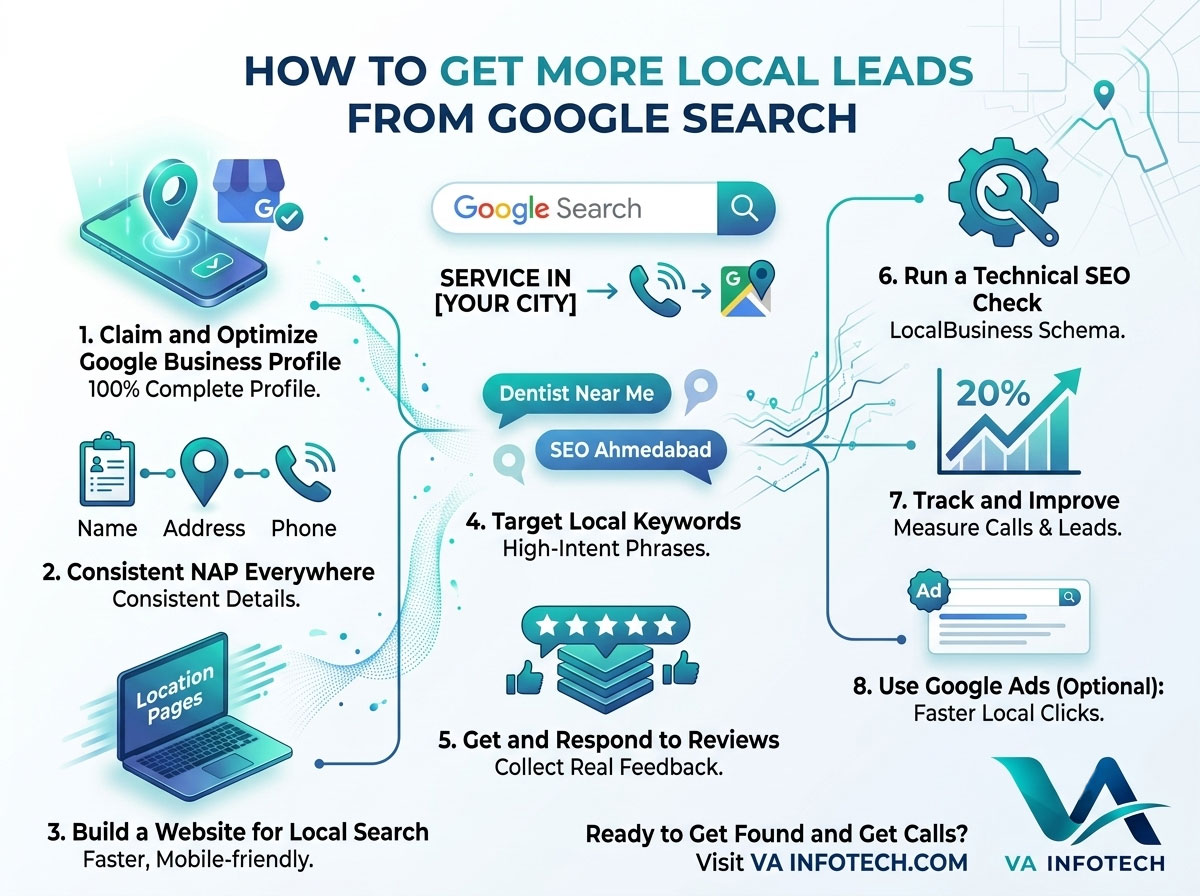
When someone types “dentist near me,” “best interior designer in Ahmedabad” or “website design company near me,” they aren’t browsing. They want to call, visit or buy today. That makes local search one of the highest-intent sources of customers a small business can have.
The catch is that only a handful of businesses appear in the local results, and those businesses collect most of the calls, direction requests and enquiries. If you aren’t one of them, a competitor is getting your customers.
This guide from Va Infotech explains how to get more local leads from Google Search. It covers what Google looks at, the steps that move the needle, and how to measure whether your effort is bringing in real enquiries.
Why Local Leads From Google Matter So Much
Local search traffic is different from general traffic. Visitors are close by, they have a specific need, and they are usually ready to act. A large share of local searches lead to a call, a visit or a purchase within a short time.
Local leads also tend to cost less than leads from broad national campaigns. You compete with businesses in your area, not the whole country, and you can win with good information, good reviews and a good website rather than a huge advertising budget.
If you’re still working out how much to invest in marketing overall, our guide on how much a small business should spend on digital marketing will help you plan a sensible budget before you begin.
How Google Decides Which Local Businesses to Show
Google’s local results, often called the “Local Pack” or “Map Pack,” are the three businesses shown with a map above the regular results. Google has said that local rankings rely mainly on three factors:
- Relevance: How well your business matches what the person searched for.
- Distance: How close your business is to the searcher or to the location they named.
- Prominence: How well known and trusted your business appears, based on reviews, mentions, links and overall online presence.
You can’t change where the customer is standing, but you can improve relevance and prominence a great deal. Every step below supports one of these factors.
Step 1: Claim and Fully Optimize Your Google Business Profile
Your Google Business Profile (GBP) is the single most important local asset you own. It controls how you look in Google Maps and the local results, and it’s free.
Complete every section. Add your exact business name, address, phone number, website, opening hours, categories, services, products and a clear business description. Incomplete profiles rank lower and convert fewer visitors.
Choose the right primary category. This has an outsized effect on which searches you appear for. Pick the most specific category that describes your main service, then add secondary categories for other things you do.
Write a useful description. Explain what you do, who you serve and where, in natural language. Avoid keyword stuffing and avoid promotional claims like “best in the city.”
Add real photos and videos. Upload photos of your premises, team, work and products. Businesses with strong photos tend to receive more requests for directions and calls.
Use posts, offers and updates. Regular posts show that your business is active and give searchers a reason to contact you now.
For a full walkthrough, read our guides on how to optimize your Google Business Profile for more customers and the complete Google Business Profile SEO optimization guide.
Step 2: Keep Your NAP Consistent Everywhere
NAP stands for Name, Address and Phone number. Google compares these details across your website, your Google Business Profile and other online directories. If they disagree, Google becomes less sure about your business, and your rankings can suffer.
Check that your business name is written the same way everywhere. Use the same address format, including suite or floor numbers, and the same primary phone number. Then audit the main places your business is listed: your website footer and contact page, social media profiles, and business directories relevant to your industry and city.
Fix duplicates, outdated addresses and old phone numbers. A single consistent set of details builds the trust that supports the “prominence” signal.
Step 3: Build a Website That Supports Local Search
Your Google Business Profile gets people to notice you, but your website convinces them to act. It also gives Google more proof of what you do and where you do it.
Create dedicated location and service pages. If you serve several areas or offer several services, give each its own page with unique content. A page titled “Website Design in Ahmedabad” performs far better than a single generic services page trying to cover everything.
Put local signals in the right places. Include your city or area naturally in title tags, headings, opening paragraphs, image alt text and contact details. Embed a Google Map on your contact page.
Make it fast and mobile-friendly. Most local searches happen on phones. A slow, awkward site loses visitors before they contact you. Professional Website Design built for speed and mobile use is often the best first investment for a local business. If your existing site is outdated or not converting, a Website Redesign can fix that without losing your brand.
Make contacting you effortless. Put a clickable phone number, a short enquiry form and clear calls to action on every important page. Every extra step between interest and enquiry costs you leads.
Keep the site healthy. Broken plugins, outdated software and downtime hurt both users and rankings. Regular Website Maintenance covers updates, security and speed, and reliable Web Hosting keeps your site fast and available. It’s also wise to follow a solid website backup strategy so a problem never takes your lead source offline.
Step 4: Target the Right Local Keywords
Ranking for the wrong words brings visitors who never become customers. Local keywords usually combine a service with a place or a “near me” intent, for example:
- “SEO company in Ahmedabad”
- “website design near me”
- “emergency plumber in [area]”
- “best [service] for small businesses in [city]”
Look for phrases that show buying intent, not just curiosity. Search terms that include words like “hire,” “near me,” “cost,” “prices” or “company” usually come from people close to a decision.
Our guide on how to find high-value keywords for your business shows how to research these phrases and choose the ones worth targeting. Once you have your list, map each keyword to a specific page so that every page has one clear purpose.
Step 5: Get More Reviews, and Respond to All of Them
Reviews are among the strongest signals for both rankings and conversions. Google uses them to judge prominence, and customers use them to decide whom to call.
Ask at the right time. Request a review right after a successful job, delivery or positive conversation, when the experience is fresh. Send a short message with your direct review link so that leaving one takes seconds.
Make it a routine. Build the request into your process, such as a follow-up message after each completed order, instead of asking only when you remember.
Respond to every review. Thank people who leave positive reviews, and reply to negative ones calmly and professionally. Responses show future customers that you care, and they add fresh, relevant content to your profile.
Never fake it. Fake reviews, paid reviews and review gating (only asking happy customers) violate Google’s guidelines and can lead to penalties or removal of your listing. Genuine reviews take longer but last.
Where relevant, mention the service or location naturally in your replies. For example, “Thank you, we’re glad our team could help with your website redesign in Ahmedabad.”
Step 6: Build Local Citations and Local Links
Citations are mentions of your business name, address and phone number on other websites, such as business directories, industry listings and local chambers of commerce. Links from local, relevant websites also tell Google that real people in your area know and trust you.
Good sources include:
- Reputable business directories for your industry and city
- Local business associations and chambers of commerce
- Local news sites, blogs and event organizers you can genuinely contribute to
- Suppliers, partners and clients who can link to you from their websites
- Sponsorships or community events you take part in
Focus on quality over quantity. A few relevant, trusted listings help more than dozens of low-quality directories.
Step 7: Create Helpful Local Content
Content lets you rank for more searches and shows customers that you understand their needs. Local businesses often overlook it, which creates an opportunity.
Ideas that attract local leads include:
- Answers to the questions customers ask you most often
- Guides written for your area, such as regulations, seasons or local conditions that affect your service
- Case studies and portfolio examples from local clients
- Comparison and pricing guides that help people decide
- Announcements, events and community involvement
Write for people first. Use plain language, clear headings, short paragraphs and useful detail. Add internal links to related pages so visitors and search engines can find your key service pages. For instance, a post about local marketing can link to your Search Engine Optimization and Digital Marketing pages, and browsing the Blog shows readers more resources.
Step 8: Run a Technical SEO Check
Even great content and profiles struggle if technical problems hold your website back. Common local issues include slow loading, poor mobile layout, missing title tags, duplicate pages, broken links, missing schema markup and pages that aren’t indexed.
Add LocalBusiness schema markup to your site so Google can read your name, address, hours and services clearly. Make sure your site uses HTTPS and has an XML sitemap submitted through Google Search Console.
Work through our complete SEO audit checklist for business websites to find and fix the problems that limit your rankings. If you sell products online as well as locally, the ecommerce SEO checklist for new online stores covers the extra steps for product pages, categories and store setup.
Step 9: Use Google Ads for Faster Local Leads
SEO and profile optimization take time. If you need enquiries sooner, or you’re launching a new service, paid search can fill the gap while your organic presence grows.
Local ad campaigns let you target people in a specific city or radius, show your phone number and location, and only pay when someone clicks or calls. The key is careful setup: relevant keywords, negative keywords to filter out poor searches, strong ad copy and a landing page built to convert.
Professional PPC Setup and Marketing keeps spend focused on searches that bring real customers. A practical approach is to begin with a small daily budget, learn which ads and keywords produce enquiries, then increase spend on what works.
Step 10: Support Local Search With Social Media
Social media isn’t a direct ranking factor for local search in the same way as reviews or your profile, but it supports it in several ways. It builds brand recognition, so more people search for your name directly. It gives customers another place to see your work and read feedback. And it drives traffic and engagement that keep your business visible.
Post consistently on the two or three platforms where your customers spend time, share local projects and customer stories, and link back to your website. Our Social Media Marketing service helps businesses plan content, run campaigns and manage their community.
Step 11: Prepare for AI-Powered Search
More people now ask AI tools and AI-generated search summaries for local recommendations, such as “Who is a trustworthy website design company in Ahmedabad?” These systems favor businesses with clear, consistent, well-structured information across the web.
Clear service descriptions, consistent business details, strong reviews, helpful FAQ content and structured data all help. Our Large Language Model SEO service helps businesses appear in AI-generated answers as well as traditional search results, so you stay visible as search changes.
Step 12: Track Your Results and Improve
You can’t improve what you don’t measure. Track these numbers every month:
- Google Business Profile insights: calls, direction requests, website clicks and how customers found you
- Google Search Console: impressions, clicks and rankings for local keywords
- Google Analytics: traffic from local search, enquiry form submissions and phone call clicks
- Lead quality: how many enquiries became paying customers
- Review count and rating: your progress against nearby competitors
- Local rankings: how you appear for key searches in different parts of your service area
Ask every new customer how they found you, and record the answer. This simple habit often reveals which channels are working better than your analytics show.
Review results monthly and adjust every quarter. Local SEO usually shows early movement within a few weeks, but meaningful, stable growth commonly takes three to six months, depending on competition.
Common Local SEO Mistakes to Avoid
- Ignoring your Google Business Profile after setting it up. Profiles need regular updates, photos and responses.
- Inconsistent business details. Different names, addresses or phone numbers across the web confuse Google.
- Keyword stuffing your business name. Adding extra keywords to your Google profile name can lead to suspension.
- Using one page for every service and location. Give important services and areas their own pages.
- Buying fake reviews or links. The short-term gain is not worth the risk of penalties.
- Having a slow or non-mobile-friendly website. You lose visitors before they contact you.
- Giving up too early. Local SEO is a steady process. Stopping after a month wastes the groundwork.
- Not tracking calls and enquiries. Without data, you can’t tell what’s working.
Local Lead Generation Checklist
Use this quick list to review your progress:
- Google Business Profile claimed, verified and 100% complete
- Correct primary and secondary categories selected
- Consistent name, address and phone number everywhere
- Fast, mobile-friendly website with clear calls to action
- Separate pages for key services and locations
- Target keywords researched and mapped to pages
- Regular process for collecting new reviews
- Every review answered
- Citations and local links built from trusted sources
- Helpful local content published on a schedule
- Technical SEO issues fixed and schema added
- Monthly tracking of calls, enquiries and rankings
Frequently Asked Questions
How long does it take to get more local leads from Google?
Most businesses see early improvement in visibility within a few weeks of optimizing their Google Business Profile. Stable growth in rankings and leads typically takes three to six months, depending on your competition and how much work you put in.
Do I need a website to get local leads from Google?
You can appear in local results with only a Google Business Profile, but a good website greatly improves both your rankings and your conversions. It gives Google more information about you and gives customers more reason to trust and contact you.
How many reviews do I need to rank well locally?
There’s no fixed number. Aim for a steady flow of genuine reviews, and compare yourself to the businesses that currently rank above you. Recent, detailed reviews from real customers matter more than a single burst of ratings.
Is local SEO better than Google Ads for small businesses?
They work best together. Google Ads bring quick leads, while local SEO builds lasting visibility and a lower cost per lead over time. Many small businesses run ads while their SEO grows.
Can a new business rank in the local results?
Yes. A new business can compete by completing its profile, getting its first genuine reviews, publishing helpful content and building consistent local citations. It takes patience, but new businesses do earn local rankings.
Final Thoughts
Getting more local leads from Google Search isn’t about tricks. It’s about making it easy for Google and for customers to see that your business is real, relevant and trusted. Claim and complete your Google Business Profile, keep your details consistent, build a fast and helpful website, collect genuine reviews, create useful content and measure what happens.
At Va Infotech, we help businesses in Ahmedabad and across India get found on Google and turn searches into enquiries, from Website Design and Search Engine Optimization to PPC Setup and Marketing and complete Digital Marketing. You can see examples of our work in our Portfolio and learn more on the About Us page.
Ready to get more local leads? Visit vainfotech.com, explore our Services, or contact us for a free consultation. Our team will review your current local presence and suggest a practical plan to bring you more calls, visits and customers.