How Much Does Ecommerce Website Development Cost in India in 2026?
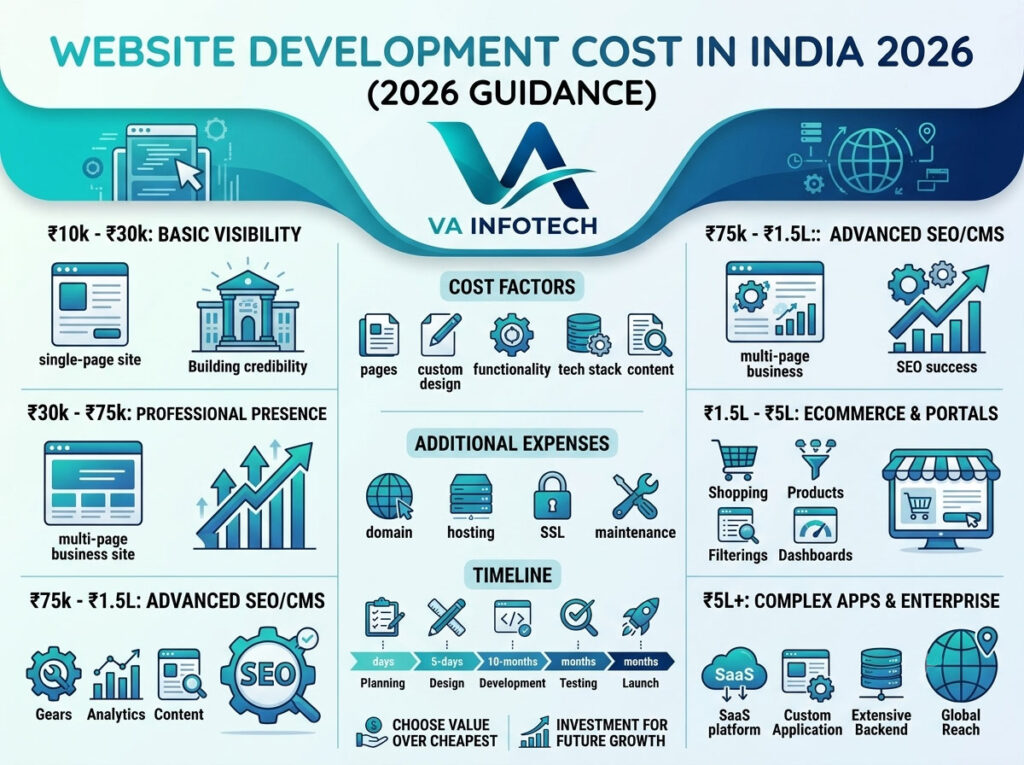
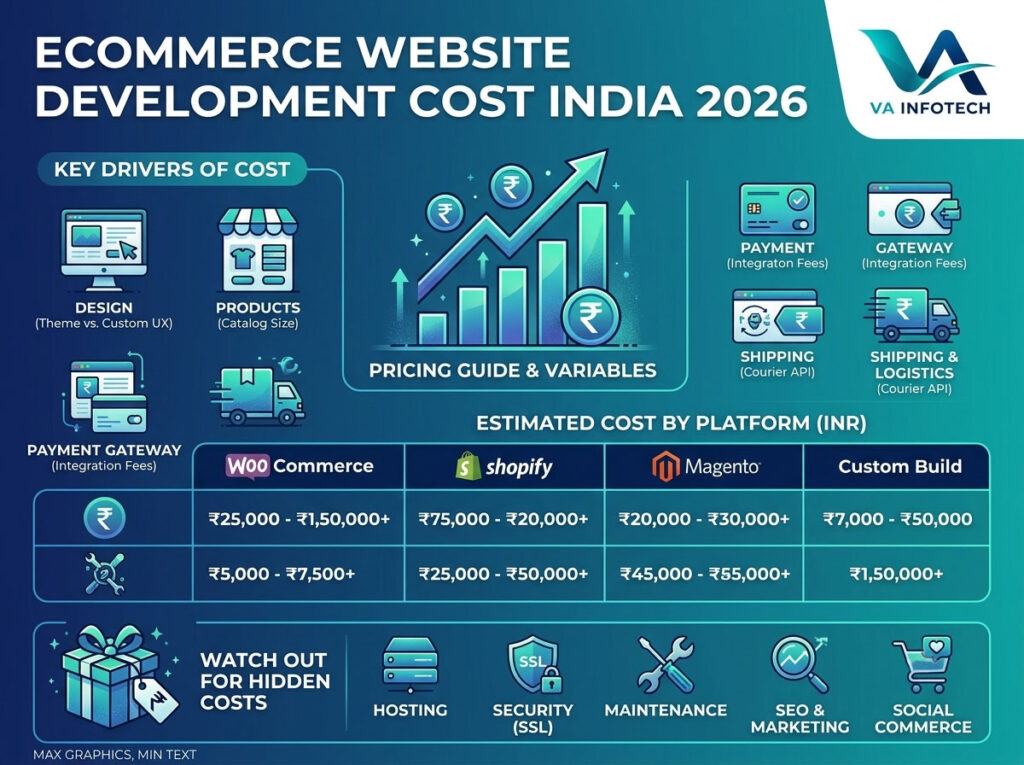
If you’ve started asking around about building an online store, you’ve probably already noticed the problem: every agency quotes a different number. One freelancer says ₹15,000. Another agency says ₹5 lakh. A third mentions “custom development” without giving you a figure at all. None of them are necessarily wrong — they’re just quoting completely different products under the same label. Ecommerce website development cost in India in 2026 depends on far more variables than a standard business website, because an online store isn’t one product — it’s a bundle of a storefront, a payment system, an inventory engine, a shipping integration, and often a mobile experience, all working together. This guide breaks down exactly what drives that cost, what realistic price ranges look like at each level, and which “hidden” expenses catch business owners off guard after launch. Why Ecommerce Pricing Varies So Much A brochure website mostly needs pages and a contact form. An ecommerce website needs to reliably handle money, inventory, taxes, shipping rules, customer accounts, and security — for potentially thousands of transactions. That complexity is exactly why pricing spreads so widely, and why comparing two quotes side by side is often comparing two entirely different scopes of work. The final cost of your project depends on: Understanding these variables first makes every quote you receive afterward much easier to evaluate. Ecommerce Website Cost by Platform (2026 Estimates) WooCommerce (WordPress-based Ecommerce) WooCommerce remains one of the most cost-effective ways to launch an online store in India, especially for small to mid-sized catalogues. Typical development costs range from ₹25,000 to ₹1,50,000, depending on design customisation and the number of plugins/integrations needed. It’s flexible, has a huge plugin ecosystem, and works well for businesses that want full ownership of their platform without ongoing licensing fees. Shopify Shopify is popular for businesses that want a faster launch with less technical maintenance. Development costs in India typically range from ₹40,000 to ₹2,00,000, on top of Shopify’s own monthly subscription (which starts at a modest fee and scales with your plan). It’s a strong choice if you want reliable uptime and built-in payment processing without managing hosting yourself. Magento / Adobe Commerce Magento is built for larger catalogues and complex business logic — multi-warehouse inventory, B2B pricing tiers, or high transaction volumes. Because of its complexity, development costs usually start around ₹2,00,000 and can extend well beyond ₹8,00,000 for enterprise-level builds. It requires more technical expertise to maintain, so factor that into your long-term budget, not just the initial build. Custom-Built Ecommerce Platforms For businesses with very specific workflows — custom pricing logic, unique checkout flows, or integrations with internal ERP/CRM systems — a fully custom build is sometimes the right call. These projects typically start at ₹3,00,000 and can run into several lakhs depending on scope, with development timelines of three to six months or more. Platform Typical Cost Range (INR) Best For WooCommerce ₹25,000 – ₹1,50,000 Small to mid-sized stores, full ownership Shopify ₹40,000 – ₹2,00,000 + subscription Fast launch, low maintenance Magento ₹2,00,000 – ₹8,00,000+ Large catalogues, complex logic Custom-built ₹3,00,000+ Unique workflows, ERP/CRM integration These are realistic starting ranges for the Indian market in 2026 — always request an itemised quote so you know exactly what’s included at your price point. What Actually Drives the Cost Up (or Down) 1. Design: Template vs. Custom UI/UX A pre-built, professionally customised theme is the most budget-friendly route and works well for most small and mid-sized stores. A fully custom design — built around your brand, your specific product presentation, and a unique user journey — costs significantly more but pays off for brands where the shopping experience itself is a differentiator. If you’re unsure which route fits your brand, it’s worth reviewing our broader Website Design approach before deciding on ecommerce-specific customisation. 2. Number of Products and Variants A catalogue of 50 simple products is a very different job from 5,000 products with size, colour, and material variants. Bulk product uploads, variant management, and filtering/search functionality all add development time — and therefore cost. 3. Payment Gateway Integration Most Indian payment gateways (Razorpay, PayU, CCAvenue, Cashfree) have straightforward integrations, but supporting multiple gateways, EMI options, or international payments (multi-currency) adds both development time and ongoing transaction complexity. 4. Shipping and Logistics Integration Connecting to courier APIs (Shiprocket, Delhivery, or a custom logistics partner) for real-time shipping rates, tracking, and label generation is a common requirement that’s often underestimated in early quotes. If your store ships pan-India or internationally, budget extra time for this integration and its testing. 5. Custom Features Features like subscription billing, loyalty/rewards programs, product customisation tools, multi-vendor marketplace functionality, or advanced filtering all add cost proportional to their complexity. It’s worth listing every feature you actually need before requesting quotes, so you’re comparing apples to apples across agencies. 6. Mobile Optimisation and App Requirements A fully responsive mobile web experience is standard and should be included in any quote. A dedicated native mobile app, however, is a separate project entirely, with its own development and App Store/Play Store costs — don’t assume it’s bundled unless it’s explicitly listed. Hidden Costs That Catch Businesses Off Guard Beyond the initial development quote, several recurring costs are easy to overlook when budgeting: A quote that only covers development and skips these ongoing costs isn’t necessarily dishonest — but it is incomplete. Ask directly what happens after launch. A Realistic Budget Breakdown Example To make this concrete, here’s what a mid-range WooCommerce store for a growing Indian business might realistically look like: Item Estimated Cost (INR) Platform setup & customised theme ₹40,000 – ₹70,000 Product upload (100–300 SKUs) ₹10,000 – ₹25,000 Payment gateway integration ₹5,000 – ₹15,000 Shipping/courier integration ₹8,000 – ₹20,000 SSL & basic security setup Included / ₹3,000 – ₹5,000 Testing & launch ₹5,000 – ₹10,000 First-year hosting & maintenance ₹20,000 – ₹40,000 Estimated Total (Year 1) ₹88,000 – ₹1,85,000 Every business’s numbers will differ, but this structure — separating one-time build costs from recurring annual costs —