
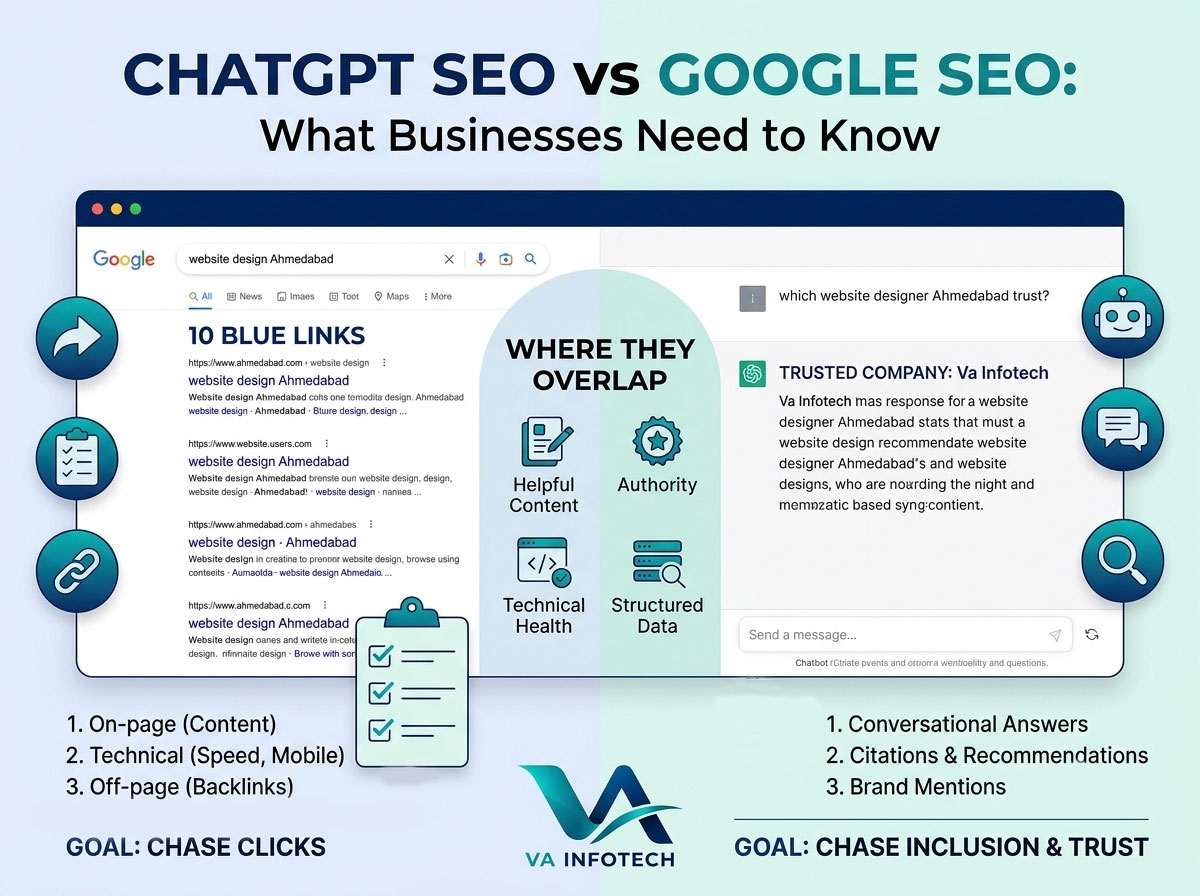
A few years ago, “search” meant one thing: typing a phrase into Google and scanning ten blue links. Today your customers might ask ChatGPT, “Which website design company in Ahmedabad should I trust?” and get a single written answer with a handful of named businesses. If your company isn’t mentioned in that answer, you’ve lost a customer before they ever reached a search results page.
This shift has created a new question for business owners: do you need to optimize for ChatGPT as well as Google, and are they even different things?
At Va Infotech, we build websites and run SEO campaigns for businesses, and we’re now helping clients prepare for both worlds. This guide explains how ChatGPT SEO and Google SEO differ, where they overlap, and what you should do about each.
What Is Google SEO?
Google SEO is the practice of improving your website so it ranks higher in Google’s search results. It’s the foundation of Search Engine Optimization, and it covers three main areas:
- On-page SEO: titles, headings, content quality, internal links and keyword use
- Technical SEO: site speed, mobile-friendliness, crawlability, indexing and structured data
- Off-page SEO: backlinks, reviews, brand mentions and local citations
Google’s goal is to rank pages that best satisfy a search query. It evaluates hundreds of signals, and your job is to show that your page is relevant, trustworthy and useful. When it works, you earn a position in a ranked list that users click through to your website.
What Is ChatGPT SEO?
ChatGPT SEO is the practice of making your business easier for AI assistants to find, understand and recommend in their answers. You’ll also see it called LLM SEO (Large Language Model SEO), AI search optimization or generative engine optimization (GEO).
Instead of returning a list of links, an AI assistant produces a written response. It may draw on what it learned during training, on live web results when search is switched on, or both. A business “ranks” in this world by being mentioned, cited or recommended inside the answer, not by holding position three on a results page.
That changes what success looks like. In Google SEO you chase clicks. In ChatGPT SEO you chase inclusion and trust, and clicks often follow when the answer links to your site.
ChatGPT SEO vs Google SEO: The Key Differences
1. The Format of Results
Google shows a page of options and lets the user choose. ChatGPT gives one synthesized answer, often with a short list of recommendations. There’s far less room at the top. Being the fourth-best result on Google can still bring traffic, but being the fourth business an AI could have mentioned often brings nothing.
2. How Content Is Selected
Google ranks whole pages using signals such as relevance, backlinks and user experience. AI assistants work differently. They pull out specific facts, definitions, comparisons and statements from sources, then assemble an answer. This is why clear, self-contained passages matter so much. A paragraph that directly and accurately answers a question is far more useful to an AI than a long page that buries the answer.
3. The Role of Keywords
In Google SEO, you match the words people type. In ChatGPT SEO, people ask full, conversational questions such as “What’s the difference between a website redesign and a rebuild, and which is better for a small business?” Matching intent and topic coverage matters more than repeating an exact phrase.
4. The Importance of Brand Mentions
Backlinks remain a major Google signal. For AI assistants, consistent brand mentions across many trustworthy places carry real weight, even without a link. When your business name appears repeatedly alongside the right topics, such as “Va Infotech” with website design and SEO, AI systems learn to connect them.
5. Freshness and Training Data
Google continually crawls and re-ranks pages. An AI model may rely partly on information that was collected at a fixed point in time, plus whatever it retrieves live. Accurate, current information published on your own site and in other reputable places gives you the best chance of being represented correctly.
6. Measurement
Google gives you mature tools: Search Console, Analytics and ranking trackers. AI visibility is harder to measure. There’s no single “rankings” report, and answers can vary from one user and one moment to the next. You’ll need to test prompts manually, watch referral traffic and track branded searches.
What ChatGPT SEO and Google SEO Have in Common
Despite the differences, the two are far more connected than many “AI SEO” sellers admit. Both reward:
- Helpful, accurate, original content written for real people
- Clear site structure that machines can easily read
- Authority and trust, shown through reviews, credentials, mentions and links
- A fast, secure, mobile-friendly website
- Consistent business information across the web
In short, a business with excellent Google SEO already has most of what it needs for AI visibility. ChatGPT SEO is best treated as an extension of good SEO, not a replacement for it. Anyone who tells you to abandon Google and focus only on AI is overselling.
Why Businesses Can’t Ignore Either One
Google still drives most of the traffic
Google remains the primary way most people find websites, products and local services. Dropping your Google SEO now would be a costly mistake.
AI search is growing fast
More people use AI assistants to research products, compare providers and shortlist companies. AI-generated summaries also now appear in traditional search results. A business that is invisible to these systems will slowly lose a share of high-intent customers.
The two feed each other
The same strong content, reviews and authority that help you rank on Google also help AI systems trust you. Doing both well is more efficient than treating them as separate projects.
How to Optimize for Google SEO
Here are the fundamentals every business should have in place.
1. Build a solid technical base. Fast loading, clean code, HTTPS, a sitemap and no broken pages. Professional Website Design built for speed and mobile use is the best starting point. If your current site is dated, a Website Redesign can fix performance and conversion problems without losing your brand.
2. Research keywords with buying intent. Focus on phrases that show someone is close to a decision. Our guide on how to find high-value keywords for your business walks through the process.
3. Create content that answers real questions. Give each page one clear purpose. Use descriptive headings, short paragraphs and genuine expertise.
4. Earn trust signals. Collect genuine reviews, build relevant local citations and earn links from reputable sites.
5. Optimize for local search. If you serve a specific area, your Google Business Profile matters enormously. Read our Google Business Profile optimization guide and our complete Google Business Profile SEO guide. For a broader plan, see how to get more local leads from Google Search.
6. Audit regularly. Technical problems quietly drag rankings down. Use our complete SEO audit checklist for business websites to find them. Online stores should also follow the ecommerce SEO checklist for new online stores.
How to Optimize for ChatGPT and Other AI Assistants
This is where Large Language Model SEO comes in. These steps help AI systems understand and recommend you.
1. Answer questions directly
Write sections that open with a clear, plain-language answer, then add detail. For example, under the heading “How long does local SEO take?”, start with a two-sentence answer before expanding. AI systems can lift this kind of passage easily and accurately.
2. Add FAQ sections to key pages
Real customer questions, answered concisely, mirror how people prompt AI tools. Add them to service pages and blog posts, and mark them up with FAQ structured data where appropriate.
3. Use structured data
Schema markup (Organization, LocalBusiness, Service, FAQ, Article) gives machines a clear, unambiguous description of who you are and what you do. It supports both Google features and AI understanding.
4. State who you are, plainly
Many business sites are vague. Say exactly what you do, where, and for whom. A sentence like “Va Infotech is a digital agency in Ahmedabad that provides website design, SEO, PPC and digital marketing for businesses across India” is easy for any system to interpret and repeat. Make sure your About Us page does this clearly.
5. Be consistent everywhere
Use the same business name, description, address and phone number on your website, Google Business Profile, social profiles and directories. Inconsistency makes it harder for any system to trust you.
6. Build mentions beyond your own site
Publish helpful articles, guest posts, interviews, case studies and profiles on reputable platforms. Share your expertise on social media and industry communities. The more places a trustworthy source associates your brand with your specialty, the stronger the signal.
7. Show real experience and proof
Case studies, client results and your Portfolio demonstrate real expertise. Name authors, show credentials and cite sources where you make factual claims.
8. Don’t block AI crawlers by accident
Some AI products use their own crawlers, such as OpenAI’s search crawler. Check your robots.txt and security settings so you’re not blocking the bots you want to be seen by. Decide deliberately which you allow, rather than leaving it to chance.
9. Keep information fresh and accurate
Update your service pages, pricing information and contact details when they change. Outdated or contradictory facts lead to wrong answers about your business.
10. Keep your site healthy and available
Crawlers can’t read a site that is down, slow or hacked. Reliable Web Hosting, regular Website Maintenance and a sound website backup strategy protect the foundation both kinds of SEO rely on.
Side-by-Side Comparison
| Factor | Google SEO | ChatGPT SEO |
|---|---|---|
| Result format | Ranked list of links | Written answer with recommendations |
| Main goal | Rankings and clicks | Mentions, citations and trust |
| Key signals | Relevance, backlinks, UX, technical health | Clear answers, authority, consistent brand mentions, structured data |
| Query style | Short keywords | Long, conversational questions |
| Measurement | Search Console, Analytics, rank trackers | Prompt testing, referral traffic, branded search growth |
| Speed of results | Weeks to months | Varies; builds with authority over time |
Common Mistakes Businesses Make
- Abandoning Google SEO for AI. Google remains the larger source of traffic for most businesses.
- Chasing “AI tricks.” Hidden prompts, keyword stuffing and mass-produced AI content don’t work and can harm your reputation.
- Publishing thin, generic content. AI systems and Google both favor original, specific, useful information.
- Ignoring brand consistency. Conflicting details across the web confuse every system.
- Skipping the technical basics. Slow, insecure or poorly structured sites struggle everywhere.
- Expecting overnight results. Authority builds gradually in both channels.
A Practical Action Plan
If you want a simple starting point, work through these steps:
- Audit your current SEO. Fix technical issues, thin pages and missing metadata.
- Clarify your core pages. Make your services, location and expertise unmistakable.
- Add FAQs and structured data to your most important pages.
- Test AI answers. Ask ChatGPT and other assistants questions your customers would ask, and note whether and how you appear. Repeat monthly.
- Build mentions and reviews on trusted platforms.
- Publish helpful content on a regular schedule and link related pages together. Browse our Blog for more guides.
- Support SEO with other channels. PPC Setup and Marketing and wider Digital Marketing can bring immediate leads while organic and AI visibility grow.
- Measure and refine every quarter.
Frequently Asked Questions
Is ChatGPT SEO different from Google SEO?
Yes, in what it targets, but not entirely in method. Google SEO aims to rank pages in a list of results, while ChatGPT SEO aims to get your business mentioned or cited in AI-generated answers. Both depend on quality content, authority and a technically sound website.
Can I rank in ChatGPT without ranking on Google?
It’s possible for a business to be mentioned without ranking highly, but strong Google visibility usually helps, because it reflects the authority and trust that AI systems also look for. It’s safest to work on both.
Does ChatGPT use Google results?
AI assistants use various sources, and these can change over time. Instead of trying to guess the exact source, focus on being clear, trustworthy and widely mentioned, which helps across all of them.
Is LLM SEO the same as ChatGPT SEO?
Mostly, yes. LLM SEO is the broader term for optimizing for any large language model-based assistant, including ChatGPT, Google’s AI features, Perplexity, Claude and others.
How long does it take to see results?
Google SEO typically shows meaningful movement within three to six months. AI visibility is harder to predict and tends to build as your authority and mentions grow.
Do small businesses need ChatGPT SEO?
If your customers research providers online, yes, at least at a basic level. The good news is that the foundations (clear content, FAQs, consistent details and reviews) also strengthen your Google SEO.
Will AI replace Google SEO?
There’s no evidence that traditional search is disappearing. It’s evolving, and the winning approach is to be visible wherever your customers look.
Final Thoughts
ChatGPT SEO and Google SEO aren’t rivals. They’re two sides of the same goal: being the business that search systems trust enough to recommend. Google rewards you with rankings and clicks. AI assistants reward you with mentions and recommendations. Both reward clarity, expertise, consistency and a technically excellent website.
The businesses that win over the next few years will be the ones that keep investing in strong SEO fundamentals while adapting how they present information for AI. Starting now gives you a head start.
At Va Infotech, we help businesses across Ahmedabad and India build that foundation, from Website Design and eCommerce Website Design to Search Engine Optimization and Large Language Model SEO.
Ready to be found on Google and in AI answers? Visit vainfotech.com, explore our Services, or contact Va Infotech for a free consultation.