If you run a local business, you have probably heard that you need to “get listed” in dozens of online directories. For years, that was standard local SEO advice. Then Google changed, AI search arrived, and many business owners began to wonder whether citations are now a waste of time.
The honest answer is more nuanced. Local citations no longer work as a quick trick to climb the map results, but they still matter as part of a solid local presence. In this guide, Va Infotech explains what local citations are, whether they still help SEO, which ones are worth your time and how to build them without wasting money.
What Is a Local Citation?
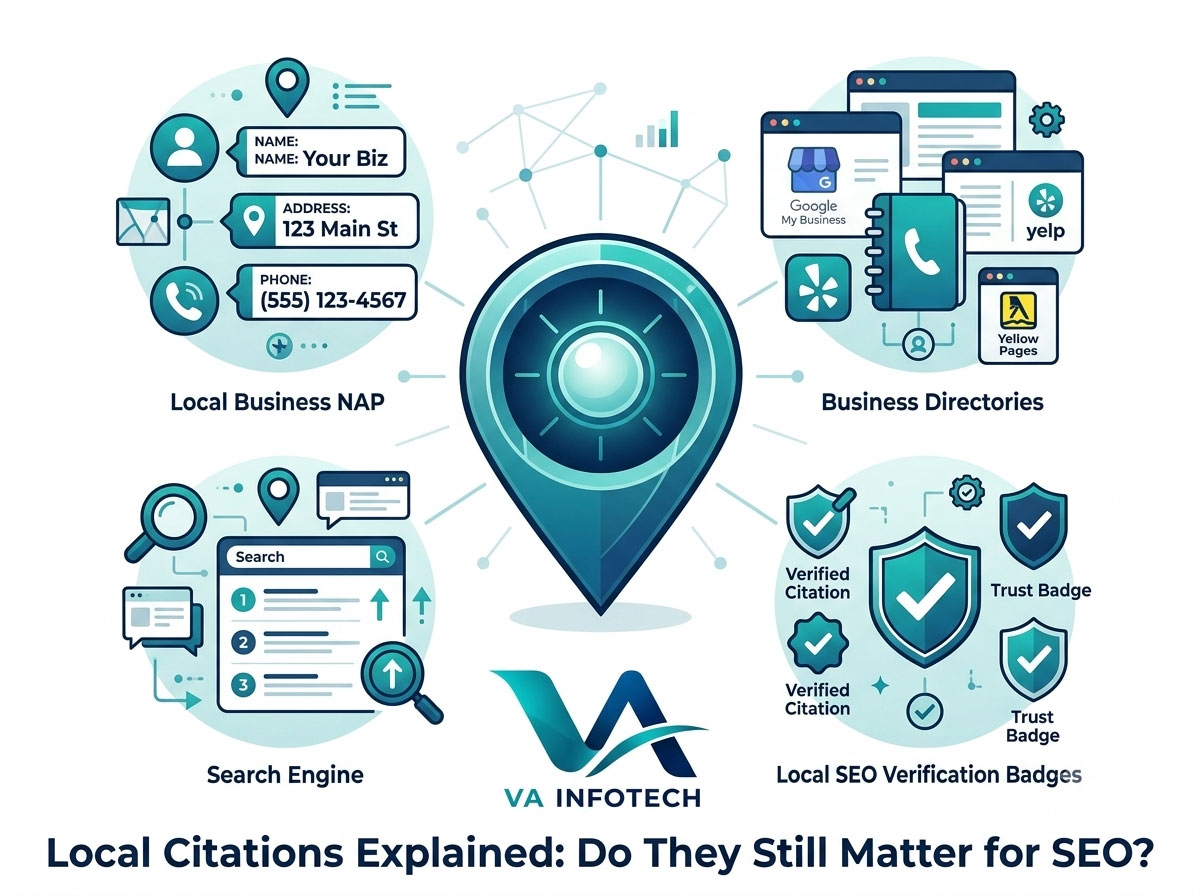
A local citation is any online mention of your business that includes some or all of these details:
- Name
- Address
- Phone number
- Often also your website URL, opening hours, categories and description
This combination is known as NAP, and it is the core of every citation. Citations appear in business directories, maps and navigation apps, social platforms, review sites, local news sites, chamber of commerce pages and industry-specific listings.
A citation does not always need a link to your website. That is one key difference between a citation and a backlink. A citation says “this business exists at this location.” A backlink says “this page recommends or references that page.”
Structured vs unstructured citations
Structured citations are listings in directories with set fields, such as Google Business Profile, Bing Places, Apple Business Connect, Yelp or an industry directory. You fill in a form, and your details appear in a consistent format.
Unstructured citations are mentions in free-form content, such as a local newspaper article, a blog post about a community event or a supplier’s “where to buy” page. They are harder to build but can be valuable because they come with real local context.
Do Local Citations Still Matter for SEO?
Short answer: yes, but their role has changed.
In the past, simply having the same business listed on many directories could noticeably lift local rankings. Today, search engines have far more signals to work with, including your Google Business Profile, reviews, website content, proximity to the searcher, user behavior and mentions across the web. Citations are one input among many, and having hundreds of low-quality listings will not outrank a business with strong reviews and a well-built website.
Still, citations continue to earn their place for three reasons.
1. They confirm that your business is real and consistent
Search engines try to decide whether the business data they hold is trustworthy. When your name, address and phone number match across many reliable sources, that agreement acts as confirmation. When details conflict, it creates doubt, and doubt can hold back your visibility.
2. They feed the data ecosystem that other platforms use
Maps, navigation apps, voice assistants and AI tools often pull business information from a range of sources, not just from Google. If your details are wrong in those sources, customers can be sent to an old address or a disconnected number. Accurate citations protect you from that.
3. They support discovery beyond Google
People find businesses on Bing, Apple Maps, Yelp, Facebook, industry directories and AI assistants. A strong set of citations puts you in front of customers on all of these, not only in Google results. If you are thinking about AI-driven discovery, our guide on ChatGPT SEO vs Google SEO explains why consistent information across the web matters more than ever.
What Has Changed in Recent Years
Understanding the shift helps you spend your effort wisely.
Quality now beats quantity. A listing on a respected, relevant platform is worth far more than 100 listings on obscure directories that nobody visits.
Google Business Profile is the main event. For most local searches, your Google Business Profile is the single most important asset. Citations support it, but they do not replace it. Our complete Google Business Profile optimization guide shows how to set it up properly.
Reviews and engagement carry more weight. Fresh, genuine reviews and active profiles send stronger signals than a long list of static listings.
Your website matters more. Search engines read your site to confirm what you do and where. Clear location pages, consistent contact details and fast loading all help.
AI search relies on consistent facts. AI-generated answers draw on information spread across the web. Conflicting details make it harder for these systems to describe your business correctly. See our article on Google AI Overviews SEO for more on this shift.
Which Businesses Benefit Most From Citations?
Citations are most valuable for:
- Businesses with a physical location such as shops, clinics, restaurants, salons and offices
- Service-area businesses such as plumbers, electricians, consultants and agencies that serve specific cities
- New businesses that need to establish trust and visibility quickly
- Businesses that have moved, rebranded or changed phone numbers, because old details linger online
- Multi-location businesses, where consistency across locations is hard to maintain
Purely online businesses that serve customers nationally will see less impact from local citations, though a few key listings can still help with credibility.
The Citations That Are Actually Worth Building
Instead of chasing a huge number, focus on tiers.
Tier 1: Core platforms every local business needs
- Google Business Profile
- Bing Places for Business
- Apple Business Connect
- Facebook Business Page
- Your main social profiles
These power maps, search and discovery for the majority of customers.
Tier 2: Major directories and review sites
Choose the ones that are popular in your country and industry. Examples include Yelp, Justdial, Sulekha or IndiaMART for businesses in India, depending on your sector, and similar leading directories in other regions. Pick platforms that real customers use, not just ones that appear in a generic “top 100” list.
Tier 3: Industry and niche directories
These are listings specific to your field, such as legal directories for law firms, medical directories for clinics or home-service marketplaces for contractors. They are highly relevant and often convert better than general directories.
Tier 4: Local and community sources
Chambers of commerce, business associations, local news sites, event pages, sponsorship pages and neighborhood portals. These are harder to get but carry strong local relevance.
What to skip
Skip low-quality directories with no real audience, paid “submit to 500 sites” packages, and any directory that looks spammy or hides its ownership. They add little value and can create inconsistent data that you will later have to clean up.
NAP Consistency: The Foundation of Citation Work
Consistency is the single most important rule. Your details should match everywhere, down to small formatting choices.
Common inconsistencies that cause problems:
- “Street” in one listing and “St.” in another
- A suite number missing from some listings
- An old phone number still showing on forgotten directories
- Different business names, such as “Va Infotech” vs “Va Infotech Pvt Ltd” vs “VA Info Tech”
- A tracking phone number on some listings and the main number on others
How to handle it:
- Decide on one official version of your business name, address and phone number.
- Write it down in a shared document.
- Use that exact version everywhere, including your own website.
Minor variations will not destroy your rankings, but clear conflicts, such as two different addresses, are worth fixing.
How to Build Local Citations Step by Step
Step 1: Audit what already exists
Before creating anything new, search for your business name, phone number and old addresses. Note every listing you find, whether the details are correct and who controls the account. Many businesses discover duplicate or outdated listings they never created.
Step 2: Fix and claim existing listings
Claim the listings you can, correct wrong details and request removal of duplicates. Duplicates are especially harmful because they split reviews and confuse search engines.
Step 3: Complete the core platforms first
Fill every field in Google Business Profile, Bing Places, Apple Business Connect and Facebook. Add accurate categories, services, opening hours, photos and a clear business description.
Step 4: Add relevant industry and local listings
Build listings on directories that match your industry and city. Use the same category and description style where possible, and add real photos instead of leaving profiles bare.
Step 5: Link back to the right pages
Where a listing allows a website link, point to the most relevant page. A single-location business can link to the homepage, while a multi-location business should link each listing to its own location page.
Step 6: Track everything
Keep a simple spreadsheet with the directory name, login details, the date you listed, the data used and the status. This makes future updates much easier.
Your Website Is Part of the Citation Picture
Citations point to your business, but your website is the source of truth they should agree with. To support your listings:
- Put your NAP in your site footer and on your contact page in plain text
- Create unique pages for each location or service area, with local details instead of copied text
- Add LocalBusiness schema markup with your accurate details
- Embed a map on your contact page
- Make sure the site loads fast on mobile
A slow or outdated site weakens even the best citation work. If your site needs attention, read why website speed gets slower over time, or consider a Website Redesign to improve both user experience and search performance. Good planning also helps, so see our guide on how to plan a business website before starting development.
Local Citations vs Backlinks: What Is the Difference?
People often mix these up, so here is a quick comparison.
- Citations confirm your business details. They may or may not contain a link, and their main job is to build trust and consistency.
- Backlinks are links from other websites to yours. Their main job is to pass authority and relevance.
Both matter for local SEO, but they play different roles. Citations establish that you exist and where you are. Backlinks show that others consider your content worth referencing. A balanced strategy includes both, supported by useful content on your site. Our Search Engine Optimization service brings these pieces together.
Common Local Citation Mistakes
- Chasing volume. Hundreds of low-quality listings add clutter, not value.
- Ignoring duplicates. Multiple listings for one business split signals and confuse customers.
- Using inconsistent details. Variations in name, address and number weaken trust.
- Forgetting to update after a move or rebrand. Old listings keep sending customers to the wrong place.
- Leaving profiles half-empty. Incomplete listings look unreliable and convert poorly.
- Using fake addresses or keyword-stuffed business names. This violates platform guidelines and can get listings suspended.
- Buying cheap bulk citation packages. Many create inconsistent or unusable listings.
- Never revisiting listings. Data goes out of date, so schedule a regular review.
How to Measure Whether Citations Are Working
Citations rarely produce overnight jumps. Track progress with indicators like:
- Growth in Google Business Profile views, calls and direction requests
- Improved visibility for local keywords and map results
- More branded searches and direct visits
- Referral traffic from directory listings
- Fewer customer complaints about wrong details
Tie these numbers to revenue so you can judge the value of the work. Our guide on how to calculate digital marketing ROI shows how to do that properly. For a broader health check, run through our complete SEO audit checklist.
Combining Citations With the Rest of Your Local Strategy
Citations work best as part of a complete approach:
- Research local keywords so your pages match how nearby customers search. Start with our guide to local keyword research.
- Create content that matches intent. Our explanation of search intent shows how to build pages people actually want.
- Turn visibility into enquiries using the tactics in how to get more local leads from Google Search.
- Improve conversions with better layouts and calls to action, as covered in how user experience affects website conversion rates.
- Add paid reach with PPC Setup and Marketing while organic rankings build.
- Stay active socially through Social Media Marketing, which also creates useful brand mentions.
- Prepare for AI search with Large Language Model SEO, which helps AI tools understand and mention your business accurately.
- Bring it all together through a structured Digital Marketing plan.
If you also sell online, citations are only one part of the picture. Pair them with our ecommerce SEO checklist for new online stores and learn how to optimize your category pages.
Local Citation Checklist
- Official business name, address and phone number decided and documented
- Existing listings audited and duplicates removed
- Google Business Profile fully completed
- Bing Places and Apple Business Connect claimed
- Facebook and key social profiles updated
- Relevant industry and local directories added
- Same NAP used on your website footer and contact page
- LocalBusiness schema added
- Listings linked to the right pages
- Reviews monitored and answered
- Tracking sheet created
- Listings reviewed at least twice a year
Frequently Asked Questions
What is a local citation in SEO? A local citation is any online mention of your business name, address and phone number, usually on directories, maps, social platforms and review sites. It helps search engines and customers confirm your business details.
Do local citations still help rankings? Yes, but they are one factor among many. They are most useful for establishing trust and consistency, and they support your Google Business Profile, reviews and website instead of replacing them.
How many citations do I need? There is no magic number. Focus on a smaller set of accurate, relevant listings, starting with the core platforms, then add industry and local sources. Quality and consistency matter far more than volume.
What is NAP consistency? NAP stands for name, address and phone number. NAP consistency means using the same details in the same format across your website and every listing.
Are paid citation services worth it? Some reputable services help manage listings, but cheap bulk packages often create low-quality or inconsistent listings. Check what you are buying, and make sure you keep control of every account.
What is the difference between a citation and a backlink? A citation mentions your business details and may not include a link. A backlink is a link from another site to yours, mainly used to pass authority.
How long do citations take to show results? It varies, but you may see listings appear within days or weeks, while ranking and traffic improvements usually build over a few months alongside your other SEO work.
Do online-only businesses need local citations? Less so. If you do not serve a local area, focus on core business profiles and credibility signals instead of building a large citation set.
Can wrong citations hurt my business? Yes. Incorrect addresses or phone numbers can confuse search engines and send customers to the wrong place, which costs you leads and trust.
Final Thoughts
Local citations are no longer a shortcut to the top of the map pack, but they remain a reliable foundation for local SEO. They confirm your business details, support your Google Business Profile, help customers find you across platforms and give AI tools consistent facts to work with.
Start by auditing what exists, fix inconsistencies, complete your core profiles and add a focused set of relevant listings. Then support that work with a fast, well-built website, strong reviews and helpful content.
At Va Infotech, we help businesses across Ahmedabad and India build a strong local presence, from Website Design, Website Maintenance and Web Hosting to ongoing SEO and marketing. You can see examples of our work in our Portfolio, learn more about us, or browse more guides on our Blog.
Want your business to show up accurately and rank higher in local search? Visit vainfotech.com or contact Va Infotech for a free consultation.
Want help applying this to your website?
Tell us about your business and goals. We will review your site and suggest clear next steps, free of charge.