A few years ago, “getting found online” meant one thing: ranking on Google. Today your potential customers also ask ChatGPT, Gemini, Perplexity and Copilot for recommendations. They read AI summaries at the top of search results. Some of them never click a blue link at all.
This shifts the question every business owner should ask. It is no longer only “Does my website rank?” It is also “Does my website make sense to the machines that now describe my business to the world?”
That is what LLM optimization is about. This guide explains how search engines and large language models (LLMs) actually process your website, what they look for, and what you can do to make your content easy to find, understand, quote and trust. At Va Infotech, we work on both traditional SEO and AI search visibility for clients, and the practical steps below come from that work.
What Is LLM Optimization?
LLM optimization is the practice of structuring your website, content and brand signals so that large language models can understand them accurately and include them in generated answers. You may also see it called LLM SEO, AI search optimization or generative engine optimization (GEO).
It does not replace SEO. It builds on it. Search engines still crawl, index and rank pages. AI tools often rely on the same web content, either through their own training data, through live retrieval of web pages, or through a search engine’s index. A site that is hard to crawl, thin on substance or unclear about who it is serves neither audience well.
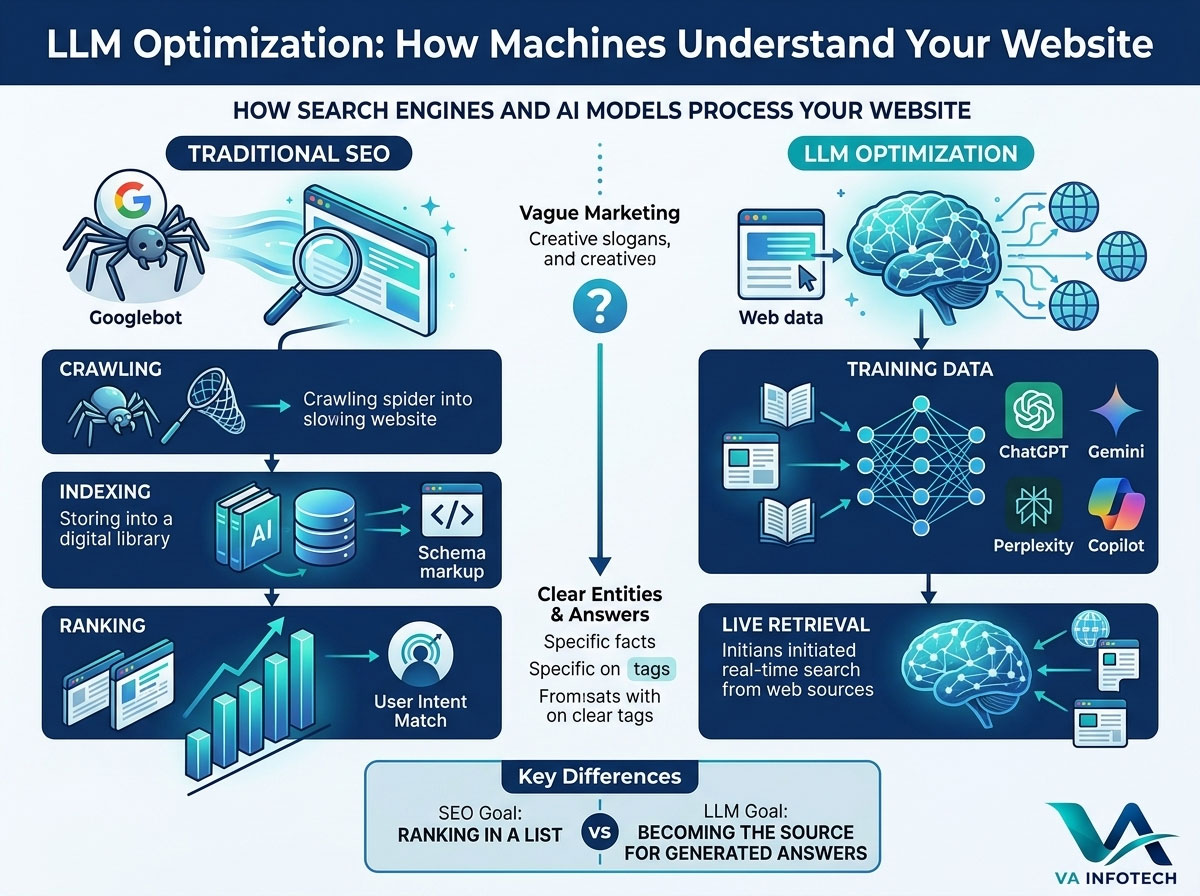
The key difference is the goal. Traditional SEO aims to rank a page in a list of results. LLM optimization aims to make your brand and content the source an AI system pulls from when it writes an answer. If you want a closer comparison of the two, read our guide on ChatGPT SEO vs Google SEO.
How Search Engines Understand Your Website
Before looking at AI models, it helps to understand the process search engines follow. It has three broad stages.
1. Crawling. Automated programs called crawlers follow links from page to page and download content. If a page cannot be reached, because of a broken link, a blocked directory or a server error, it cannot be understood.
2. Indexing. The search engine analyses the page: its text, headings, images, links and structured data. It decides what the page is about and stores it in a large database.
3. Ranking. When someone searches, the engine selects indexed pages and orders them according to relevance, quality, usability and many other signals.
Search engines look at far more than keywords. They evaluate:
- Page content and headings, to work out the topic
- Internal links, to understand how pages relate and which matter most
- Backlinks and mentions, as signals of authority
- Page experience, including speed, mobile usability and security
- Structured data, which labels things like business details, products and reviews
- Search intent match, meaning whether the page gives the kind of answer the searcher wanted
That last point matters more than most people realise. Our article on search intent explained shows how to match content to what searchers actually want.
How AI Models Understand Your Website
Large language models work differently. They do not “rank” pages the way a search engine does. They process language and predict useful responses. There are two main ways your website ends up in an AI answer.
Route 1: Training data
LLMs learn from huge collections of text, which can include web pages, articles, books and public documents. During training, the model learns patterns: which brands are associated with which topics, how concepts relate, which facts appear consistently across many sources.
This means clear, consistent, widely corroborated information about your business has a better chance of being represented accurately. Contradictory details, such as different business descriptions on different sites, create confusion.
Route 2: Live retrieval
Many AI tools now search the web in real time. When you ask a question, the system may run a search, retrieve several pages, read them and write an answer based on what it found. Google’s AI Overviews work this way, as do Perplexity and ChatGPT’s search features.
In this route, your page has to be retrievable, which is a traditional SEO task, and then easy for the model to read, extract and trust. We cover this in depth in our guide to Google AI Overviews SEO.
What LLMs actually “see”
LLMs process text, not visual design. They do not admire your layout. They read your words, your heading hierarchy, your lists and tables, and your markup. A beautiful page that hides its key information inside images, sliders or heavy scripts may be nearly invisible to them.
They are also looking for entities: clearly identifiable things such as a company, a person, a product, a place or a service. If your website makes it obvious that Va Infotech is a web design and digital marketing company in Ahmedabad that offers specific services, an AI system can connect your brand to those topics with more confidence than if your site only uses vague slogans.
Why Clarity Beats Cleverness
Marketing copy often leans on creative phrases such as “We turn dreams into digital reality.” A human may smile. A machine learns nothing from it.
Compare these two lines:
- Vague: “We craft digital experiences that elevate your brand.”
- Clear: “Va Infotech designs and builds business websites, online stores and SEO campaigns for companies in Ahmedabad and across India.”
The second line tells search engines and AI models who you are, what you do and where you do it. Write the clear version first. You can add personality around it.
9 Practical Steps to Improve LLM Optimization
1. Make your website easy to crawl and render
Everything starts with access. Check that:
- Important pages are not blocked in robots.txt or by noindex tags
- Your XML sitemap is current and submitted to Google Search Console
- Key content appears in the HTML rather than loading only through heavy JavaScript
- There are no long redirect chains or broken links
Be aware that different AI companies use different crawlers, and you can allow or block them in your robots.txt file. Decide deliberately which ones to permit, based on whether you want your content to appear in AI answers. Technical health also depends on reliable infrastructure, so good web hosting with strong uptime and speed supports both users and crawlers.
2. Structure your pages with a clear heading hierarchy
Use one H1 that states the page topic, then H2 and H3 headings that break the topic into logical parts. Phrase headings as the questions or topics people actually search for.
Good structure helps a search engine understand sections, and it helps an LLM pull a precise passage. A page that answers “How much does a business website cost?” under a heading with that exact meaning is far easier to quote than a long unbroken wall of text. This is also why planning your page layouts early matters, as we explain in how to plan a business website before starting development.
3. Answer questions directly and early
AI systems favour content that gives a clear answer quickly. Open each section with a concise, direct statement, then expand with detail, examples and context.
For instance, if your heading is “What is keyword mapping?”, your first sentence should define it in plain words. Then continue with the process. Our guide on keyword mapping is a good example of assigning each page a clear purpose, which also helps machines understand it.
4. Use structured data (schema markup)
Schema markup is code that labels your content in a standard vocabulary. It tells machines explicitly that something is an organisation, a local business, a product, an FAQ, an article or a review.
Useful types include:
- Organization and LocalBusiness, for company name, address, phone, logo and social profiles
- Article or BlogPosting, for author and publication details
- FAQPage, for question-and-answer sections
- Product and Review, for online stores
- BreadcrumbList, for site structure
Structured data does not guarantee rankings or AI citations, but it removes guesswork. Always validate it with Google’s testing tools. If you run an online store, pair this with the advice in our product page SEO and category page SEO guides, and consider a properly built eCommerce website design.
5. Build topical authority, not just single pages
Neither search engines nor AI models trust a business based on one lucky article. They respond to depth. If your site covers a subject thoroughly, with a main service page supported by related guides, case studies and FAQs, you become a recognisable source on that topic.
Plan clusters. For example, around website design you might publish content on planning, UX, platforms, speed, security and migration. Link these pieces together so the relationships are obvious. Some of ours include website UX vs UI, WordPress vs custom website development and our website migration checklist. You can browse more on the Va Infotech blog and in the Web Design category.
6. Strengthen internal linking
Internal links are how both crawlers and AI retrieval systems understand which pages are related and which are most important. Use descriptive anchor text, such as “website redesign services” rather than “click here.”
Link from blog posts to relevant service pages, and from service pages back to supporting guides. For example, a business with an outdated site should be able to move naturally from an educational article to a website redesign page. Likewise, a post about visibility should lead to your search engine optimization service.
7. Show real expertise, experience and trust
Google’s quality guidelines emphasise experience, expertise, authoritativeness and trustworthiness, often shortened to E-E-A-T. AI systems that rely on web content benefit from the same signals. Show them clearly:
- Named authors or a clear team page, such as your About Us page
- Real case studies and a visible portfolio
- Accurate contact details, address and business registration information
- Customer reviews and testimonials
- Original insights, data and examples rather than recycled generic advice
- Regular updates so information stays current
Thin, copied or mass-produced content is a weak signal for both search engines and AI models. Original, useful detail is what gets quoted.
8. Keep your brand information consistent everywhere
LLMs build their picture of your business from many places, not only your own website. Make sure your company name, description, address, phone number, services and social links are consistent across:
- Your website
- Google Business Profile
- Business directories
- Social media profiles
- Press mentions and guest posts
If you serve specific locations, strengthen those signals with local content. Our guides on local keyword research and getting more local leads from Google search explain how. Active profiles and helpful posts through social media marketing add to the web of mentions that machines read.
9. Protect speed, usability and security
Slow, unstable or insecure websites damage user experience and can hinder crawling. Sites often get slower as plugins, images and scripts pile up, which we explain in why website speed gets slower over time. Regular website maintenance keeps software updated and problems fixed, and a solid website backup strategy protects you if something goes wrong.
Remember that usability still matters even if an AI summary sends the visitor. When people do arrive, a clear layout and fast pages convert them, as covered in how user experience affects website conversion rates.
What About llms.txt and Other New Ideas?
You may have heard of llms.txt, a proposed file that would give AI systems a curated summary of your site’s key pages. At the time of writing, it is a community proposal rather than a confirmed standard that major search engines or AI companies are known to rely on. Adding one is low-risk and some businesses do it, but do not expect it to replace the fundamentals above. Content quality, crawlability, structure and authority still do the heavy lifting.
The same caution applies to anyone promising guaranteed AI rankings. These systems change often, and no one outside the companies that build them controls the results. Focus on durable practices instead.
Common LLM Optimization Mistakes
- Treating it as a separate trick. It sits on top of good SEO, not beside it.
- Hiding content in images or scripts. If key text is not readable in the page code, machines may miss it.
- Writing vague marketing copy. Say plainly what you do and for whom.
- Ignoring technical health. Broken links, slow pages and blocked resources hurt everything.
- Publishing thin or duplicated pages. Quantity without substance weakens trust.
- Inconsistent business details. Different names, addresses or descriptions confuse entity recognition.
- Never updating content. Outdated facts are less likely to be trusted or quoted.
- Measuring only rankings. Track brand mentions, branded searches, referral traffic and enquiries too.
How to Measure Your Progress
AI visibility is harder to measure than rankings, but you can still track useful signals:
- Search Console data: impressions, clicks and queries for your key pages
- Branded search growth: more people searching your company name often signals rising awareness
- Referral traffic: visits from AI platforms, which can appear in Google Analytics 4 as referrals
- Manual testing: ask AI tools questions your customers would ask and note whether your brand appears and whether the details are correct
- Lead quality: enquiries that mention they found you through an AI tool or a recommendation
Connect these figures to revenue so you know what is working. Our post on how to calculate digital marketing ROI walks through the method, and if you are deciding how much to invest, see how much a small business should spend on digital marketing.
A Simple LLM Optimization Checklist
- Important pages are crawlable and indexable
- Each page has one clear topic and a logical heading structure
- Key questions are answered directly near the top of sections
- Schema markup is added and validated
- Topic clusters link to each other with descriptive anchor text
- Author, company and contact details are clear and consistent
- Content includes original examples, data or experience
- Business profiles match across the web
- Site speed, security and mobile usability are healthy
- AI visibility is tested and tracked regularly
Final Thoughts
Search engines and AI models read your website differently, but they reward the same things at heart: clear structure, accurate information, real expertise and a trustworthy brand. Websites that explain themselves well to a machine are usually the ones that also serve people best.
Start with the basics. Make your site easy to crawl, organise your pages around clear topics, answer questions plainly, add structured data and keep your information consistent. Then build depth over time with useful content and strong internal links.
At Va Infotech, we help businesses prepare for both traditional search and AI-driven discovery. Our Large Language Model SEO service focuses on making your brand easier for AI systems to understand and cite, while our SEO, digital marketing and website design teams make sure the foundations are strong. If paid visibility is part of your plan, our PPC setup and marketing service and guide on PPC landing pages can help you convert the traffic you earn.
Ready to see how your website looks to search engines and AI models? Contact Va Infotech for a free consultation, explore our full range of services, or visit vainfotech.com to learn more.
Frequently Asked Questions
What is LLM optimization?
LLM optimization is the process of structuring your website content and brand signals so large language models can understand them, trust them and use them in AI-generated answers. It builds on traditional SEO rather than replacing it.
How do search engines understand a website?
Search engines crawl pages, index their content and evaluate signals such as headings, internal links, structured data, page experience, backlinks and how well the page matches search intent. They then rank pages for relevant queries.
How do AI models find information about my business?
They draw on training data that may include public web content, and many also retrieve live web pages through search at the moment a question is asked. Clear, consistent and well-structured information improves the chance of accurate representation.
Is LLM SEO different from traditional SEO?
The foundations are shared: crawlability, quality content, authority and good user experience. LLM SEO adds extra focus on clear entity information, direct answers, structured data and consistency across the web so AI systems can cite you with confidence.
Does schema markup help with AI search?
Schema markup helps machines understand your content explicitly. It does not guarantee AI citations or rankings, but it reduces ambiguity and supports rich results in traditional search.
Can I block AI crawlers from my website?
Yes. Most major AI companies publish crawler names that you can allow or disallow in robots.txt. Decide based on whether you want your content to appear in AI answers, and review the policy periodically since it changes.
How long does it take to see results?
Technical fixes can be picked up within weeks, but authority and brand recognition build over months. Treat it as a long-term investment and track progress with Search Console, referral data and manual AI testing.
Do small businesses need LLM optimization?
Yes. Local and small businesses often benefit most, since AI tools frequently recommend specific providers. Accurate business details, helpful local content and strong reviews improve your chances of being mentioned.
Want help applying this to your website?
Tell us about your business and goals. We will review your site and suggest clear next steps, free of charge.