You pay for every click on your ads. If the page behind that click does not convince the visitor to act, that money is gone. Many businesses spend weeks perfecting ad copy, keywords, and budgets, then send traffic to a homepage or a generic service page and wonder why enquiries stay low.
The fix is rarely more budget. It is a better PPC landing page.
In this guide, Va Infotech explains what a PPC landing page is, why it decides the success of your campaign, and how to build one that turns ad clicks into real customers. You will get a clear structure, practical best practices, common mistakes to avoid, and a checklist you can use before your next campaign goes live.
What Is a PPC Landing Page?
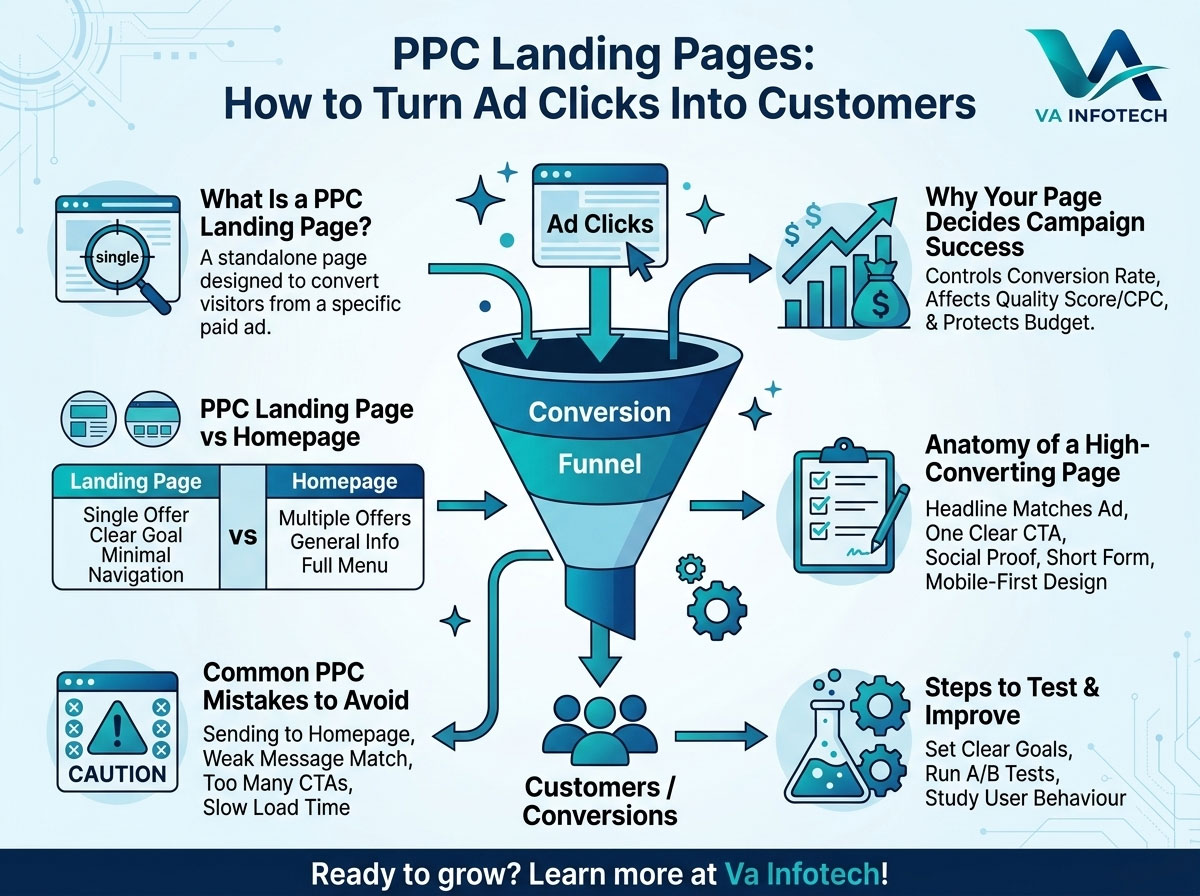
A PPC landing page is a standalone web page built for one purpose: to convert visitors who arrive from a paid ad. That ad might come from Google Ads, Microsoft Advertising, or a paid social campaign. The page has one offer, one message, and one action for the visitor to take, such as calling, filling in a form, booking a consultation, or requesting a quote.
It differs from a regular website page in an important way. A homepage or service page serves many audiences and offers many paths. A landing page removes distractions and guides the visitor toward a single goal.
That focus matters because paid visitors are impatient. They clicked an ad with a specific promise in mind. If they cannot see that promise fulfilled within a few seconds, they leave, and you still pay for the click.
Why Landing Pages Decide the Success of Your PPC Campaign
The ad earns the click, but the landing page earns the customer. Here is why the page deserves as much attention as the ad itself.
It Controls Your Conversion Rate
Your landing page conversion rate is the share of visitors who complete the action you want. Two businesses can pay the same amount per click and get very different results purely because one page is clearer, faster, and more persuasive than the other.
It Affects Your Quality Score and Cost Per Click
Google Ads looks at landing page experience as part of the quality of your ads. A page that is relevant to the ad, easy to use, and quick to load supports a stronger quality score, which can help you earn better ad positions at a lower cost. A weak page can push your costs up even when your ad copy is strong.
It Protects Your Budget
Every visitor who leaves without acting is wasted spend. Improving the page lets the same budget produce more leads. This is why how much a small business should spend on digital marketing is only half the question. How well that spend converts matters just as much.
It Gives You Data to Learn From
Because a landing page has a single goal, results are easy to measure. You can test one change at a time and see exactly what helps. That makes your whole campaign smarter over time.
Landing Page vs Homepage vs Service Page
A common mistake is sending paid traffic to the homepage. Here is how the three compare.
| Page type | Main purpose | Navigation | Best used for |
|---|---|---|---|
| Homepage | Introduce the whole business | Full menu, many links | Brand searches, general visitors |
| Service page | Explain one service in depth | Full menu, several links | Organic search, research stage |
| PPC landing page | Convert one specific ad click | Minimal or none | Paid campaigns with one offer |
A well-built website design gives you strong homepage and service pages. A PPC landing page is a different tool, designed to complement them rather than replace them.
The Anatomy of a High-Converting PPC Landing Page
Every strong landing page has the same core building blocks. Use this structure as your starting point.
1. A Headline That Matches the Ad
The headline is the first thing visitors read, so it must confirm they are in the right place. If your ad says “Affordable Ecommerce Website Design in Ahmedabad,” your headline should say the same thing or something very close. This is called message match, and it is one of the biggest drivers of conversions.
Keep the headline clear and benefit-focused. Say what you offer and who it is for. Avoid clever wording that makes people think.
2. A Supporting Subheadline
Use one or two lines to add detail. Explain how the offer works or what result the visitor can expect. A good subheadline answers the question, “What do I get, and why should I care?”
3. A Strong Hero Section
The area visible without scrolling should include the headline, a short supporting message, a relevant image or short video, and your main call to action. Visitors decide within seconds whether to stay, so this section does most of the work.
4. One Clear Call to Action
Your call to action (CTA) tells visitors exactly what to do next. Use action-focused wording such as “Get a Free Quote,” “Book a Consultation,” or “Call Now.” Make the button stand out visually and repeat it further down the page for visitors who scroll.
Avoid offering multiple competing actions. One page, one goal.
5. Benefits Before Features
Visitors care about what your service does for them. Lead with outcomes, such as more enquiries, faster load times, or an easier checkout, then support them with features. Short bullet points are easier to scan than long paragraphs.
6. Social Proof and Trust Signals
People buy from businesses they trust. Add:
- Client testimonials with names and business types
- Short case studies with real outcomes
- Logos of clients you have worked with
- Reviews and ratings from recognised platforms
- Years of experience or number of projects completed
If you have completed projects to show, link to your portfolio so visitors can see your work.
7. A Simple, Short Form
Every extra field reduces the number of people who finish a form. Ask only for what you need to follow up, usually a name, phone number, and email. If you need more detail, collect it on the first call. Add a short line beneath the form explaining what happens after submission, such as “We will call you within one business day.”
8. Contact Options for Different Visitors
Some people prefer to call. Others want to fill in a form. Show a visible phone number, ideally click to call on mobile, beside your form. Offering both reduces friction.
9. Answers to Common Objections
Visitors hesitate for predictable reasons: price, time, risk, and trust. Address these with a short FAQ section or a guarantee. A few honest answers can be the difference between a bounce and a booking.
10. A Clean Footer
Keep the footer simple with your business details, privacy policy, and contact information. This builds credibility without pulling visitors away from the offer.
PPC Landing Page Best Practices
The structure above gives you the skeleton. These best practices make it perform.
Build One Page Per Campaign or Ad Group
The more specific the match between ad and page, the better the results. If you run ads for website design, ecommerce development, and website redesign, create separate pages for each rather than one page that tries to cover everything. Visitors searching for website redesign have different needs from those searching for an online store.
Understand What the Searcher Wants
Paid searches usually carry strong buying intent, but not always. Someone searching “hire website designer” is ready to act. Someone searching “best website design company” is still comparing. Your page should match that stage. Our guide on search intent explains how to read what a searcher wants and build pages to suit.
Remove Distractions
Strip out the main navigation menu, sidebar links, and unrelated offers. Every extra link is an exit. Keep only what helps the visitor decide.
Make It Fast
Slow pages lose visitors before they read a word, and people clicking ads are especially unwilling to wait. Compress images, limit heavy scripts, and avoid unnecessary animations. A dependable web hosting setup is the foundation of speed, and regular website maintenance keeps the page quick as your site grows.
Design for Mobile First
A large share of ad clicks come from phones. Test your page on a real device. Buttons should be easy to tap, text should be readable without zooming, and forms should be short enough to complete with a thumb. Good design choices here connect directly to the principles in our guide on website UX vs UI.
Use Clear Visual Hierarchy
Guide the eye. Use size, colour, and spacing so the headline, benefit points, and CTA stand out in that order. White space is not wasted space. It helps people focus.
Write in Plain Language
Use short sentences and everyday words. Speak directly to the visitor with “you” and “your.” Avoid jargon unless your audience expects it.
Keep Your Promise
If the ad says “free quote,” the page must deliver a free quote. If it mentions a discount, show it prominently. Any mismatch between ad and page damages trust immediately.
How to Write Landing Page Copy That Converts
Good copy does not need to be clever. It needs to be clear, specific, and persuasive. Follow this simple flow.
- Name the problem. Show that you understand what the visitor is struggling with, such as a website that gets traffic but no enquiries.
- Present your solution. Explain what you offer in one or two sentences.
- Show how it works. A simple three-step process reassures visitors that the next step is easy.
- Prove it. Add testimonials, results, and examples.
- Ask for action. Finish with a confident, specific CTA.
Use numbers and specifics where you can. “We build mobile-friendly websites that load quickly” is stronger than “We build great websites.” Only use figures you can back up with real results.
Landing Pages for Different Types of Businesses
The best structure depends on what you sell.
Service Businesses
Focus on trust, process, and ease of contact. Show who you are, how you work, and what clients say. Include a form and a phone number. Local service businesses should also reinforce their area, which connects well with our advice on getting more local leads from Google search and local keyword research.
Ecommerce Stores
Send ad traffic to the most relevant product or collection page rather than the homepage. Show clear images, pricing, reviews, delivery details, and a simple buying path. Strong ecommerce website design makes this journey smoother, and our guide to product page SEO shows how to improve the page itself.
Lead Generation Campaigns
Offer something valuable in exchange for contact details, such as a free audit, a consultation, or a downloadable guide. Make the value obvious and the form short.
Local Visits and Appointments
Include your address, map, opening hours, and a booking option. For businesses where the space matters, such as hotels, showrooms, and studios, a virtual tour can build confidence before the visit.
Common PPC Landing Page Mistakes to Avoid
Even experienced advertisers repeat these errors. Check your pages against this list.
- Sending all traffic to the homepage. It dilutes the message and offers too many choices.
- Weak message match. The headline does not reflect what the ad promised.
- Too many calls to action. Visitors freeze when given several choices.
- Long, intimidating forms. More fields mean fewer submissions.
- No proof. Claims without testimonials or examples feel empty.
- Slow loading. Heavy images and poor hosting drive visitors away.
- Poor mobile experience. Tiny buttons and cramped layouts lose mobile visitors.
- Hidden contact details. If people cannot find your number, they will not call.
- Never testing. Guessing instead of measuring leaves results on the table.
- Ignoring the follow-up. A fast response to a new lead is part of conversion. A form that sends enquiries into a dead inbox wastes the whole effort.
How to Test and Improve Your Landing Page
A landing page is never finished. The best performers are improved through steady testing.
Set a Clear Goal and Track It
Decide what counts as a conversion: a form submission, a phone call, a booking, or a purchase. Set up conversion tracking in Google Ads and your analytics tool so you can see which campaigns and pages produce results, not just clicks.
Run A/B Tests
A/B testing compares two versions of a page that differ in one element. Test one change at a time so you know what caused the result. Good things to test include:
- Headline wording
- CTA text and button colour
- Form length
- Hero image or video
- Placement of testimonials
- Page length, short versus long
Let each test run long enough to collect meaningful data before choosing a winner.
Study User Behaviour
Heatmaps and session recordings show where visitors click, how far they scroll, and where they get stuck. These tools often reveal problems that numbers alone miss.
Review Search Terms and Match Them to Pages
Look at the actual search terms triggering your ads. If you see clusters of related queries, build dedicated pages for them. This works the same way as assigning one keyword to one page, which our guide on keyword mapping explains in detail.
PPC Landing Pages and SEO: Do They Work Together?
PPC landing pages are usually built for paid traffic only, and many businesses choose to keep them out of search results so they do not compete with organic pages. Even so, the two channels support each other.
Paid campaigns give you fast data on which messages, offers, and keywords convert. You can use those findings to improve your organic content. In the other direction, strong SEO builds trust and brand searches that make your ads perform better.
If you want a steady stream of visitors beyond paid traffic, invest in search engine optimization alongside your ads. Run through our SEO audit checklist to find technical problems that could affect both channels. It is also worth understanding how AI-driven search is changing visibility, which we cover in our posts on Google AI Overviews SEO, ChatGPT SEO vs Google SEO, and large language model SEO.
You can also pair paid search with social media marketing to reach people earlier in their journey, then use retargeting to bring them back to your landing page when they are ready to act. All of these channels sit within a wider digital marketing plan.
Build Versus Redesign: When to Get Professional Help
You can create a landing page with a template builder, but results depend on strategy more than tools. If your site is slow, outdated, or difficult to edit, it may be time to rethink the foundation. Our comparisons of custom website development vs website builders and WordPress vs custom website development can help you decide what suits your business.
Whatever route you take, protect your work with a reliable website backup strategy so a technical problem never takes your campaign pages offline during a busy period.
PPC Landing Page Checklist
Before you launch, confirm each of these:
- The page has one clear goal and one main CTA.
- The headline matches the ad and keyword.
- The value of the offer is clear within five seconds.
- Testimonials, reviews, or case studies are visible.
- The form is short and easy to complete.
- A click to call number is visible on mobile.
- The page loads quickly on a mobile connection.
- The design looks right on phones, tablets, and desktops.
- Main navigation and unrelated links are removed.
- A privacy policy link is included.
- Conversion tracking is installed and tested.
- Someone is ready to respond to new leads quickly.
If you can tick every box, your page is ready to turn clicks into customers.
Frequently Asked Questions
What is a PPC landing page? A PPC landing page is a focused page built to convert visitors who click a paid ad. It has a single offer and a single action, such as submitting a form or calling your business.
What makes a good landing page for Google Ads? A good page matches the ad message, loads quickly, works well on mobile, shows trust signals, and offers one clear call to action. It should also be relevant to the keywords you are targeting.
Should I send PPC traffic to my homepage? Usually not. A homepage serves many purposes and gives visitors too many choices. A dedicated landing page that matches the ad nearly always converts better.
How long should a PPC landing page be? It depends on the offer. A simple, low-risk action may need only a short page. A higher-value service usually needs more detail, proof, and answers to objections. Match the length to how much convincing your visitor needs.
How many form fields should I use? Use as few as you can. Name, phone number, and email are enough for most service businesses. Add more only if the extra information is truly needed to qualify the lead.
What is a good conversion rate for a landing page? It varies widely by industry, offer, and traffic source, so compare your page against your own past results rather than a single benchmark. Aim to improve steadily through testing.
Does a landing page affect Google Ads quality score? Yes. Landing page experience is one of the factors Google considers, alongside expected click rate and ad relevance. A relevant, fast, easy-to-use page supports a better quality score.
How often should I test my landing page? Test continuously, one change at a time. Review results after each test has gathered enough data, then apply the winner and move on to the next idea.
Can Va Infotech build and manage PPC landing pages? Yes. Va Infotech designs conversion-focused landing pages, sets up campaigns, and tracks results so your budget works harder. Learn more about our PPC setup and marketing service or contact Va Infotech to discuss your goals.
Final Thoughts
A successful PPC campaign is not just about winning clicks. It is about what happens after the click. A focused landing page with a clear message, strong proof, a simple form, and fast performance gives every visitor a reason to act and an easy way to do it.
Start with the fundamentals: match the page to the ad, remove distractions, build trust, and keep the next step obvious. Then test, learn, and improve. Small gains in conversion rate add up to far more customers from the same budget.
At Va Infotech, we help businesses plan, design, and optimise websites and campaigns that turn attention into enquiries. From website design and PPC setup and marketing to search engine optimization and ongoing support, our team is ready to help you get more from every click. Ready to grow? Contact Va Infotech today, learn more about us, or explore more guides on the Va Infotech blog.
Visit us at www.vainfotech.com.
Want help applying this to your website?
Tell us about your business and goals. We will review your site and suggest clear next steps, free of charge.