Every successful website starts the same way: with an idea and a problem to solve. Maybe you want to attract more customers, sell products online, or finally give your business a credible home on the internet. But between that first idea and a live website that actually generates leads, there is a structured journey. Businesses that understand it launch faster, spend less and avoid expensive rework.
At Va Infotech, we have guided many businesses through this journey. In this guide, we walk through the complete website development process, from the first conversation to launch day and beyond, so you know exactly what to expect and how to make each stage count for SEO and conversions.
What Is the Website Development Process?
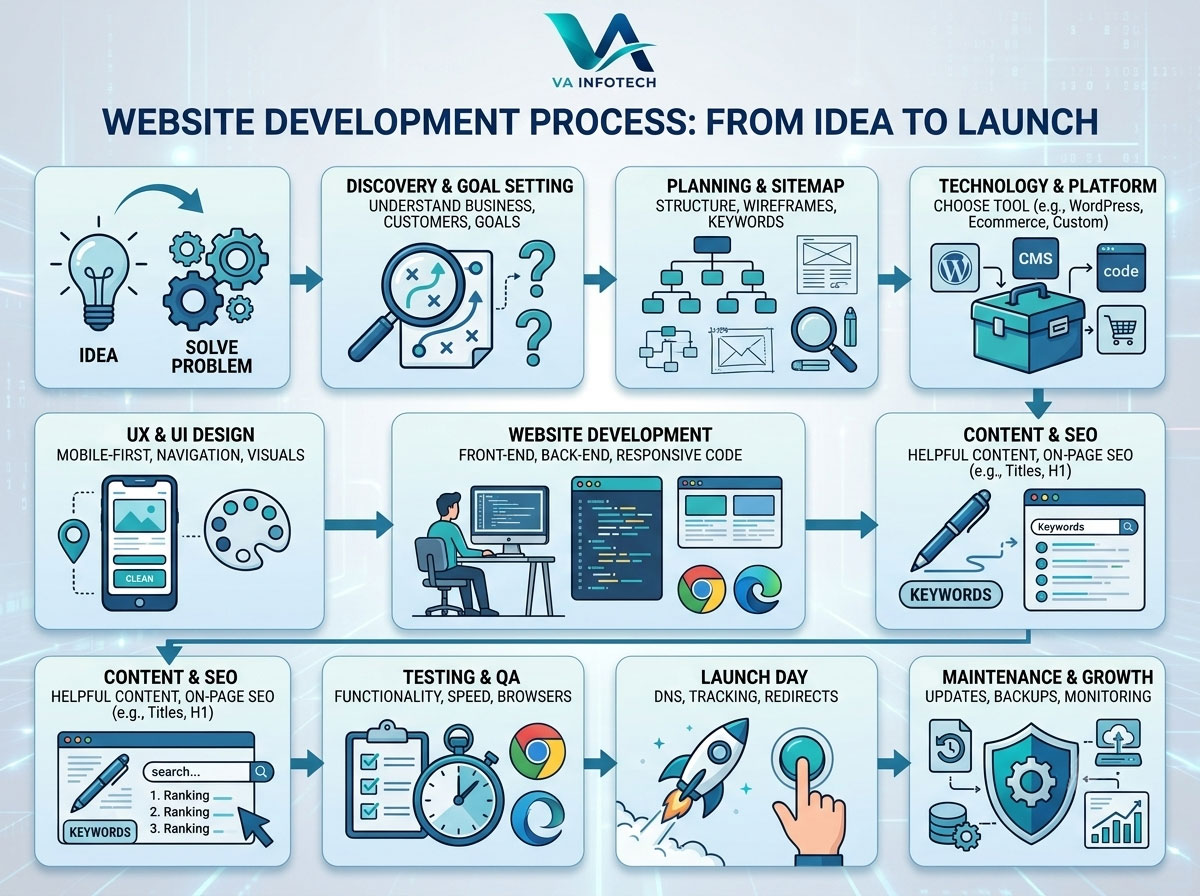
The website development process is the series of stages a team follows to turn a business goal into a working, search-friendly website. It covers discovery, planning, design, development, content, testing, launch and ongoing care.
Skipping or rushing any stage usually shows up later as slow pages, confusing navigation, poor rankings or a site that looks good but never converts. A clear process keeps everyone aligned on scope, budget and timeline, which is why professional website design services always follow one.
Let us break it down step by step.
Step 1: Discovery and Goal Setting
Every strong website begins with questions, not code. During discovery, your development partner learns about your business, your customers and what you want the website to achieve.
Key questions to answer at this stage:
- What is the main purpose of the website: leads, sales, bookings, information or brand credibility?
- Who is your ideal customer, and what are they searching for?
- Who are your top competitors, and what do their websites do well?
- What features are essential, and which can wait for a later phase?
- What is your budget and your target launch date?
Write your goals as measurable outcomes, such as “generate 40 enquiries per month” or “increase online orders by 25%.” Measurable goals make it far easier to judge the website’s success after launch. If you want a deeper walkthrough of this stage, read our guide on how to plan a business website before starting development.
Step 2: Planning, Sitemap and Content Strategy
Once goals are clear, planning turns them into a blueprint. This stage produces three important deliverables.
Sitemap. A sitemap lists every page your website needs and how pages connect. A logical structure helps visitors find information quickly and helps search engines crawl and understand your site.
Wireframes. These are simple, black-and-white layouts showing where headings, images, forms and buttons go on each page. Wireframes let you approve structure before spending time on visual design.
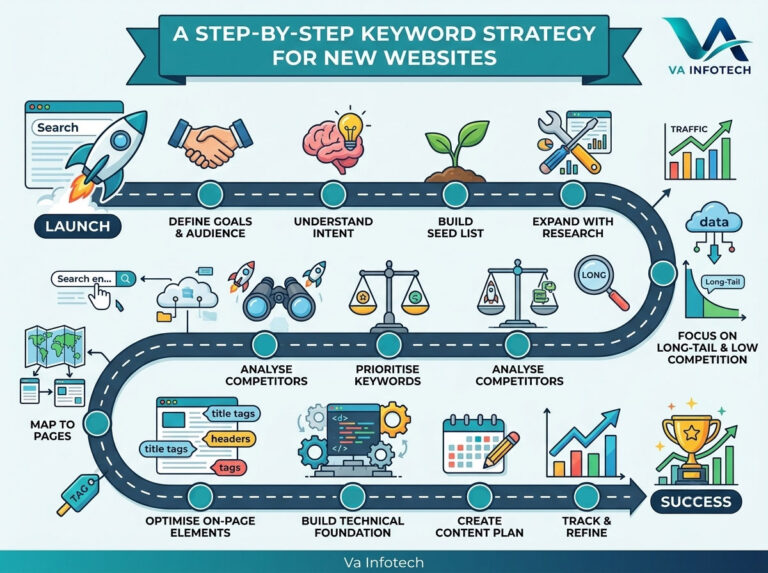
Keyword and content plan. This is where SEO should begin, not end. Research the phrases your customers use, then decide which page targets which keyword. Our articles on how to build a keyword strategy for a new website and keyword mapping explain exactly how to do this. It also helps to understand search intent, so each page matches what visitors actually want when they search.
Planning SEO before the build prevents the common problem of having to restructure pages after launch.
Step 3: Choosing the Right Technology and Platform
The platform you choose affects cost, flexibility, security and speed. Common options include:
- WordPress or another CMS: quick to launch, easy to update, large plugin ecosystem.
- Custom development: built from scratch for unique features, complex integrations or very high performance needs.
- Ecommerce platforms: purpose-built for product catalogs, payments and inventory.
There is no single best answer. It depends on your goals, budget and growth plans. We cover the trade-offs in detail in WordPress vs custom website development: which should your business choose?
If you plan to sell products online, choose a platform built for it from the start. Our ecommerce website design service focuses on secure checkouts, smooth product management and conversion-friendly store layouts.
This is also the stage to decide on domain name and web hosting. Reliable hosting affects speed, uptime and security, so treat it as part of your foundation, not an afterthought.
Step 4: UX and UI Design
Design is more than colours and fonts. Good design guides visitors toward action while building trust.
UX (user experience) focuses on how the website works: navigation, page flow, readability and how easy it is to complete tasks. UI (user interface) focuses on how it looks: layout, typography, buttons, imagery and branding. They are different disciplines that must work together, as explained in Website UX vs UI: understanding the difference.
During this stage, designers create visual mockups of key pages, usually the homepage, a service page and a contact page, then refine them based on your feedback. Design decisions have a measurable effect on results, which we explore in how user experience affects website conversion rates.
Design tips that support both users and SEO:
- Use a mobile-first layout, since most visitors browse on phones.
- Keep navigation simple, with clear labels.
- Place one clear call to action on each page.
- Use readable fonts and strong colour contrast.
- Compress images so design does not slow the site down.
Step 5: Website Development
Now the approved designs become a real, working website. Developers handle two sides of the build:
- Front-end development: the visible parts of the website, including layouts, menus, forms and animations, built to be responsive on every screen size.
- Back-end development: the systems behind the scenes, such as the CMS, databases, user accounts, payment gateways and third-party integrations.
This is usually done on a private staging site, so nothing goes public before it is ready.
Clean code matters for SEO. Lightweight, well-structured code loads faster and is easier for search engines to read. Speed also decays over time if the site is not managed well, a problem we cover in why website speed gets slower over time and how to fix it. Building performance in from day one saves you from fixing it later.
Step 6: Content Creation and On-Page SEO
A beautiful website with thin content will struggle to rank. Content creation runs alongside development, and it should be written for people first and search engines second.
For every important page, make sure you have:
- A unique title tag and meta description containing the target keyword
- One clear H1 heading, with logical H2 and H3 subheadings
- Helpful, original content that answers the visitor’s question
- Descriptive alt text on images
- Internal links to related pages and posts
- Structured data where relevant
If you are launching an online store, pay special attention to product and category pages. Our guides to product page SEO and category page SEO show how to optimize them for Google.
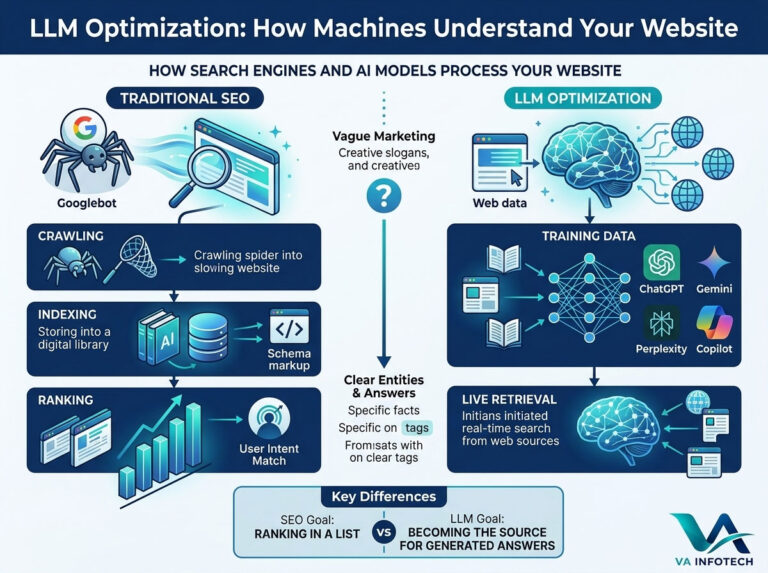
Search is also changing. People now get answers from AI tools and AI-generated summaries, so structure content clearly and answer questions directly. Learn more in Google AI Overviews SEO and LLM optimization. Our search engine optimization and Large Language Model SEO services help businesses stay visible across both Google and AI search.
Step 7: Testing and Quality Assurance
Before launch, the website must be tested thoroughly. Testing catches problems that would otherwise cost you visitors and credibility.
| Test area | What to check |
|---|---|
| Functionality | Forms, buttons, search, checkout, login, email notifications |
| Responsiveness | Phones, tablets, laptops, large screens |
| Browser compatibility | Chrome, Safari, Firefox, Edge |
| Speed | Page load time, image sizes, Core Web Vitals |
| SEO | Title tags, redirects, sitemap, robots.txt, indexability |
| Security | SSL certificate, form protection, user permissions |
| Accessibility | Keyboard navigation, contrast, alt text |
Fix every issue on the staging site and retest. A single broken contact form can quietly cost you leads for weeks, so do not rush this stage.
Step 8: Launch Day
Launch is more than flipping a switch. A careful launch checklist protects your search visibility and gives your new website the best possible start.
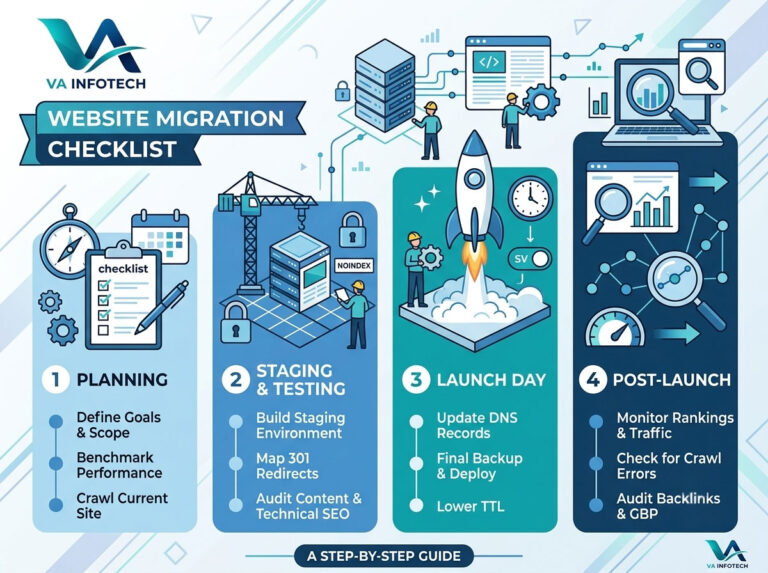
- Take a full backup of the website and database.
- Connect the final domain and confirm the SSL certificate is active.
- Remove any “noindex” settings used during development.
- Submit your XML sitemap in Google Search Console.
- Install Google Analytics and set up conversion tracking.
- Confirm that all forms, phone numbers and email addresses work.
- Redirect old URLs if you are replacing an existing website.
If you are moving from an old site, follow our website migration checklist so you do not lose existing rankings. If you are rebuilding rather than starting fresh, our website redesign service handles design, development and SEO-safe migration together.
Once live, promote the website. Digital marketing, social media marketing and PPC campaigns bring early traffic while organic rankings build. If you are unsure about budgets, see how much a small business should spend on digital marketing.
Step 9: Post-Launch Maintenance and Growth
Launch is the starting line, not the finish. A website is a living asset that needs regular care to stay secure, fast and effective.
Ongoing tasks include:
- Updating the CMS, themes and plugins
- Monitoring uptime, speed and security
- Fixing broken links and errors
- Publishing fresh content regularly
- Reviewing analytics and improving underperforming pages
- Running regular backups
A reliable backup plan is essential. Read our website backup strategy guide to learn how to protect your business website. Our website maintenance service takes care of updates, monitoring and fixes so you can focus on running your business.
Track your results too. Knowing whether your marketing pays off matters, so learn how to calculate digital marketing ROI for your business.
How Long Does Website Development Take?
Timelines depend on size and complexity, but these are typical ranges:
| Project type | Typical timeline |
|---|---|
| Small business website (5 to 10 pages) | 3 to 6 weeks |
| Medium business website with custom features | 6 to 10 weeks |
| Ecommerce website | 8 to 14 weeks |
| Custom web application | 3 months or more |
The biggest cause of delay is usually late content and slow feedback, not development itself. Prepare your text, images and approvals early and your project will move faster.
Common Website Development Mistakes to Avoid
- Skipping planning. Starting design without a sitemap or goals leads to costly changes later.
- Treating SEO as an afterthought. Adding keywords after launch is harder than building structure around them.
- Ignoring mobile users. A desktop-only mindset hurts both rankings and conversions.
- Choosing price over quality. A cheap, poorly built site often costs more to fix.
- Forgetting maintenance. Outdated websites become slow, insecure and less visible.
- Launching without tracking. Without analytics you cannot tell what is working.
Frequently Asked Questions
What are the main stages of the website development process?
The main stages are discovery, planning, design, development, content and SEO, testing, launch and post-launch maintenance. Each stage builds on the previous one, which keeps the project organized and predictable.
How much does website development cost?
Cost depends on the number of pages, features, design complexity and platform. A simple business website costs far less than an ecommerce store or custom application. A good agency will give you a clear quote after understanding your requirements.
Do I need SEO during website development?
Yes. Building SEO into the structure, content and technical setup from the beginning is more effective and cheaper than fixing it after launch.
What do I need to provide to my web development company?
Typically your logo, brand colours, page content, product details, images, and any examples of websites you like. The more complete your materials, the faster the project moves.
Will I be able to update the website myself?
In most cases, yes. A CMS such as WordPress lets you edit text, images and blog posts without coding. Your development team can train you on the basics.
Final Thoughts
A successful website is the result of a clear, repeatable process: understand your goals, plan the structure, design with users in mind, build clean and fast, test thoroughly, launch carefully and keep improving. When each stage is handled well, your website becomes a reliable engine for leads, sales and brand trust.
At Va Infotech, we combine website design, SEO and digital marketing to take your project from first idea to a high-performing launch. You can see examples of our work in our portfolio, browse more guides on our blog, or explore all services.
Ready to turn your idea into a website that grows your business? Contact Va Infotech today for a free consultation, or call us on +91 99242 41667.
Want help applying this to your website?
Tell us about your business and goals. We will review your site and suggest clear next steps, free of charge.